Blog

  • The Philipp Redeker Pinned Post – Why This Cloudflare Abuse Failure Will Never Leave the Top of Defequer (And Why Every Future Roast Comes After It)

    The Philipp Redeker Pinned Post – Why This Cloudflare Abuse Failure Will Never Leave the Top of Defequer (And Why Every Future Roast Comes After It)

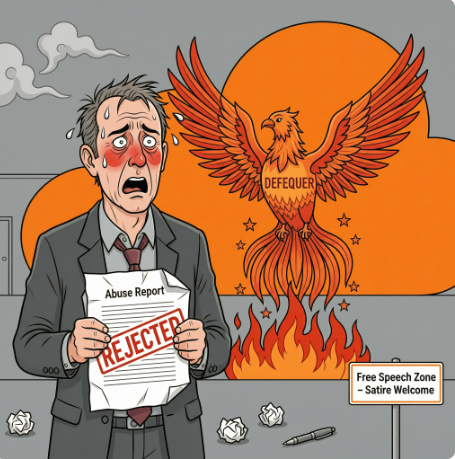
    On 27 April 2026, Philipp Redeker – Managing Partner of a German recruitment agency called OneOutOfHundred.com – filed an abuse complaint with Cloudflare.

    His target: Defequer.

    His weapon: A creatively worded claim that we violated the GDPR, published his personal data without consent, and damaged his right to conduct business.

    His result: A 24‑hour suspension, followed by a full reinstatement, and now – this article.

    Let us be clear: Defequer is a satirical website. We roast overpriced domains and the people who sell them. We do not doxx. We do not harass. We do not break the law. And we certainly do not disappear just because someone with a free GMX “lawyer” and a bruised ego decides to file a complaint.

    Mr. Redeker, this roast is for you. You tried to silence us. You failed. And now we are going to explain – to you, to Cloudflare, and to the world – exactly why your complaint was nonsense, why your threats backfired, and why you should have just let it go.

    What Actually Happened – A Timeline

    For readers who are just joining us, here is the short version:

    1. We published a roast of saudinationalteam.com, a domain listed for $15.9 million that we argued was a classic case of cybersquatting.
    2. Philipp Redeker – who apparently owns or represents that domain – sent us a legal threat demanding we remove the article.
    3. We published his email (with his signature visible, as he sent it) and wrote a satirical response.
    4. He demanded our identity, address, and “clear name.” We refused, explaining that anonymous satire is protected speech.
    5. A fake “trademark lawyer” named “Retro Valler” using a free GMX email sent us a legally dubious UDRP analysis. We roasted him too.
    6. Redeker then filed an abuse complaint with Cloudflare, falsely claiming we violated the GDPR and published his data without consent.
    7. Cloudflare forwarded the complaint to our hosting provider.
    8. Our hosting provider suspended us – for about 24 hours, until we explained the situation.
    9. We are back. Stronger. And writing this article.

    That is the sequence. Note what did not happen: No court order. No GDPR fine. No successful lawsuit. No permanent takedown. Just a 24‑hour blip caused by an automated hosting response and a complainant who confused “I am angry” with “I have a legal case.”

    Why the Cloudflare Abuse Complaint Was Frivolous

    Let us examine the complaint that Redeker filed, because it is important to understand why it failed – and why similar complaints will fail in the future.

    Redeker claimed (through Cloudflare’s reporting system) that we:

    • Unlawfully published his data after an email exchange
    • Published his contact details (email signature) without consent
    • Violated the GDPR
    • Violated his right to conduct business

    Here is why each claim is wrong, under Cloudflare’s own terms and under established law.

    Claim 1: “Unlawfully published his data after an exchange”

    Redeker sent unsolicited emails to our public contact address ([email protected]). He was not a private individual writing in confidence. He was a “Managing Partner” of a registered company, using a professional email signature that included his name, title, company name, and email address. He initiated the conversation. He did not mark his emails as “confidential” or “private.”

    Under the GDPR, the legitimate interest basis (Article 6(1)(f)) allows the processing and publication of personal data when it is necessary for the purposes of criticism, commentary, or satire – and when those interests are not overridden by the data subject’s rights. A managing partner who voluntarily emails a satirical website cannot reasonably claim that his professional signature is “private” or that its republication is unlawful.

    Moreover, the GDPR includes an explicit exemption for journalistic, academic, artistic, and literary expression (Article 85, as implemented in national laws like the German Telemediengesetz §57). Defequer’s satirical commentary falls squarely within that exemption.

    Claim 2: “Published his contact details without consent”

    Redeker provided his contact details. He typed them into his email signature. He chose what information to include. He then sent that email to us. Consent is not required when the data subject has manifestly made the data public (Article 9(2)(e) – though that applies to special categories, the principle holds generally) or when the communication was voluntary and professional.

    If Redeker did not want his email signature published, he should not have sent threatening legal emails to a satirical website. This is not complicated.

    Claim 3: “Violated the GDPR”

    The GDPR is a data protection regulation. It is not a censorship tool. It does not give individuals the right to erase any online mention of their name simply because they dislike the context. Courts across Europe have repeatedly rejected attempts to use the “right to be forgotten” or data protection laws to suppress legitimate speech, criticism, or satire.

    Notably, Redeker did not file a complaint with a data protection authority. He did not obtain a court order. He did not even send us a formal GDPR takedown request with the required statutory elements. Instead, he filed an abuse report with Cloudflare – a private company – hoping that a quick suspension would achieve what the law would not.

    That is not how the GDPR works. That is not how any of this works.

    Claim 4: “Violated his right to conduct business”

    Our articles mention Redeker’s company (OneOutOfHundred.com) in passing, in the context of explaining who he is and why his legal threats are ironic. We have not called for a boycott. We have not made false statements about his company’s services. We have simply pointed out that a recruitment agency’s managing partner spent his time sending legal threats to a satirical website over a domain name dispute.

    If that damages his “right to conduct business,” the damage is self‑inflicted. He chose to engage with us. He chose to escalate. He chose to file a frivolous abuse report. The consequences are his responsibility.

    Cloudflare’s Terms – And Why We Did Not Violate Them

    Cloudflare’s Acceptable Use Policy (AUP) prohibits using their services for:

    • Illegal activity
    • Harassment or doxxing
    • Copyright infringement
    • Malware or phishing

    None of our content falls into those categories. Satirical criticism is not harassment. Publishing an email signature that the sender voluntarily provided is not doxxing. Our articles do not incite violence, disclose private residential addresses, or reveal any information that Redeker did not put into his own emails.

    Cloudflare is a pass‑through security and CDN provider. They are not content moderators. Their abuse reporting system is designed to catch genuinely harmful content – spam, malware, child exploitation, direct threats. It is not designed to adjudicate petty disputes between a domain seller and a satirical blog.

    Cloudflare’s own Trust & Safety team almost certainly flagged Redeker’s complaint as low‑priority or simply forwarded it to the hosting provider as a courtesy. They did not suspend us. They did not issue a warning. They passed the message along. That is what good internet infrastructure providers do.

    The problem was that our hosting provider – likely overwhelmed by automated abuse reports – triggered a temporary suspension without reviewing the merits. Once we explained the situation, the suspension was lifted. That is how the system should work.

    We do not blame the hosting provider. They acted in good faith. We do not blame Cloudflare. They forwarded a report. The blame lies with the person who filed a knowingly false or exaggerated complaint in an attempt to silence critics.

    That person is Philipp Redeker.

    A Civilised Person’s Guide to Handling Online Criticism (For Philipp Redeker)

    Mr. Redeker, since you appear to be unfamiliar with how adults handle disagreement, here is a short guide.

    Step 1: Read the criticism

    Before reacting, read the article. Understand what it says. Our original saudinationalteam.com roast did not mention your name. It roasted a domain listing. You chose to insert yourself into the conversation by sending a legal threat.

    Step 2: Consider whether the criticism is fair

    Our article pointed out that a domain registered in 2025, listed for $15.9 million, with no apparent connection to the Saudi national team, looks like cybersquatting. That is a reasonable opinion. Many domain professionals would agree.

    Step 3: Respond civilly, if you must

    If you disagree, you could have left a comment, sent a polite email, or even written your own rebuttal. Instead, you sent a formal legal threat demanding removal, then escalated to demands for our identity, then to a fake lawyer, then to an abuse complaint.

    Step 4: Do not try to cancel the critic

    Filing a knowingly false or exaggerated abuse report to take down a website is not a protected activity. It can expose you to liability for abuse of process, tortious interference, or even criminal charges in some jurisdictions. It also guarantees that we will write an even longer article about you.

    Step 5: Accept that satire exists

    Satire is not a crime. Roasting is not harassment. Being mocked is not a violation of your human rights. If you cannot tolerate being made fun of, do not send threatening emails to satirical websites.

    This is not complicated, Mr. Redeker. It is basic internet etiquette.

    Defequer’s Values – And Why We Do Not Back Down

    We started Defequer to roast unreasonably priced domains and unrealistic domainer thinking. We do it with humour, with facts, and without personal attacks on private individuals. We do not doxx. We do not harass. We do not break the law.

    But we also do not tolerate attempts to silence us through bogus legal threats or fabricated abuse reports.

    Our values are simple:

    1. Satire is protected speech. We will continue to roast.
    2. Facts are not defamation. We will continue to cite real WHOIS data, real listings, and real emails (with context).
    3. Anonymous criticism is lawful. We will not reveal our identities to angry domain sellers or their recruitment agency proxies.
    4. Frivolous complaints will be exposed. We will publish every threat, every fake lawyer email, and every failed abuse report.

    We are not going anywhere.

    A Final Warning to Philipp Redeker (And Anyone Else Thinking of Filing a False Complaint)

    Mr. Redeker, you have now:

    • Sent multiple threatening emails
    • Demanded our personal information
    • Enlisted a fake “trademark lawyer” using a GMX account
    • Filed a knowingly false abuse complaint with Cloudflare
    • Caused a temporary suspension of our website

    We have responded with satire, with legal explanations, and with patience. That patience is not unlimited.

    If you continue to harass us via threatening emails, fake lawyer letters, or unfounded complaints to Cloudflare or hosting providers, we will:

    • Continue publishing every communication you send us, in full
    • Document every attempt to silence us in permanent, SEO‑optimised articles that will rank for your name and your company’s name for years

    You tried to take us down. You failed. And now your name is permanently associated with a failed censorship attempt on a satirical website. That is the permanent mark we promised.

    We would much rather not have to keep writing about you. We would rather roast domains. So here is our final offer: Stop. Do not contact us again. Do not file any more complaints. Do not send any more fake lawyers. Just walk away.

    If you do, we will not write about you again. If you do not, we will make sure that anyone who searches for “Philipp Redeker” finds these articles first.

    The choice is yours.

    Defequer Rating for Philipp Redeker’s Abuse Complaint: 💩💩💩💩💩 (5/5 shits)

    Five shits. Not for the domain this time, but for the frivolous abuse report, the fake GDPR claims, the fake “trademark lawyer,” and the desperate attempt to silence satire. Mr. Redeker has earned a place in the Defequer Hall of Shame for Censorship Attempts. The Delusion Olympics – Abuse Report Division – has a new champion.

    Roast served. Censorship attempt failed. Next frivolous complaint, please.

    Post‑Script to Our Readers

    Dear Defequer community,

    We were down for 24 hours. It was annoying. But we are back, and we are not going anywhere.

    Thank you to everyone who reached out with support. Thank you to our hosting provider for eventually doing the right thing. And thank you to Philipp Redeker for reminding us why satire matters – and why we will never stop.

    If you ever receive a threatening email or a bogus legal complaint, remember: do not panic. Do not delete. Do not back down. Respond calmly, document everything, and if you can, roast them publicly. It works.

    We will be here. Watching. And roasting.

    Defequer Editorial Team
    (Anonymous. Satirical. Reinstated.)
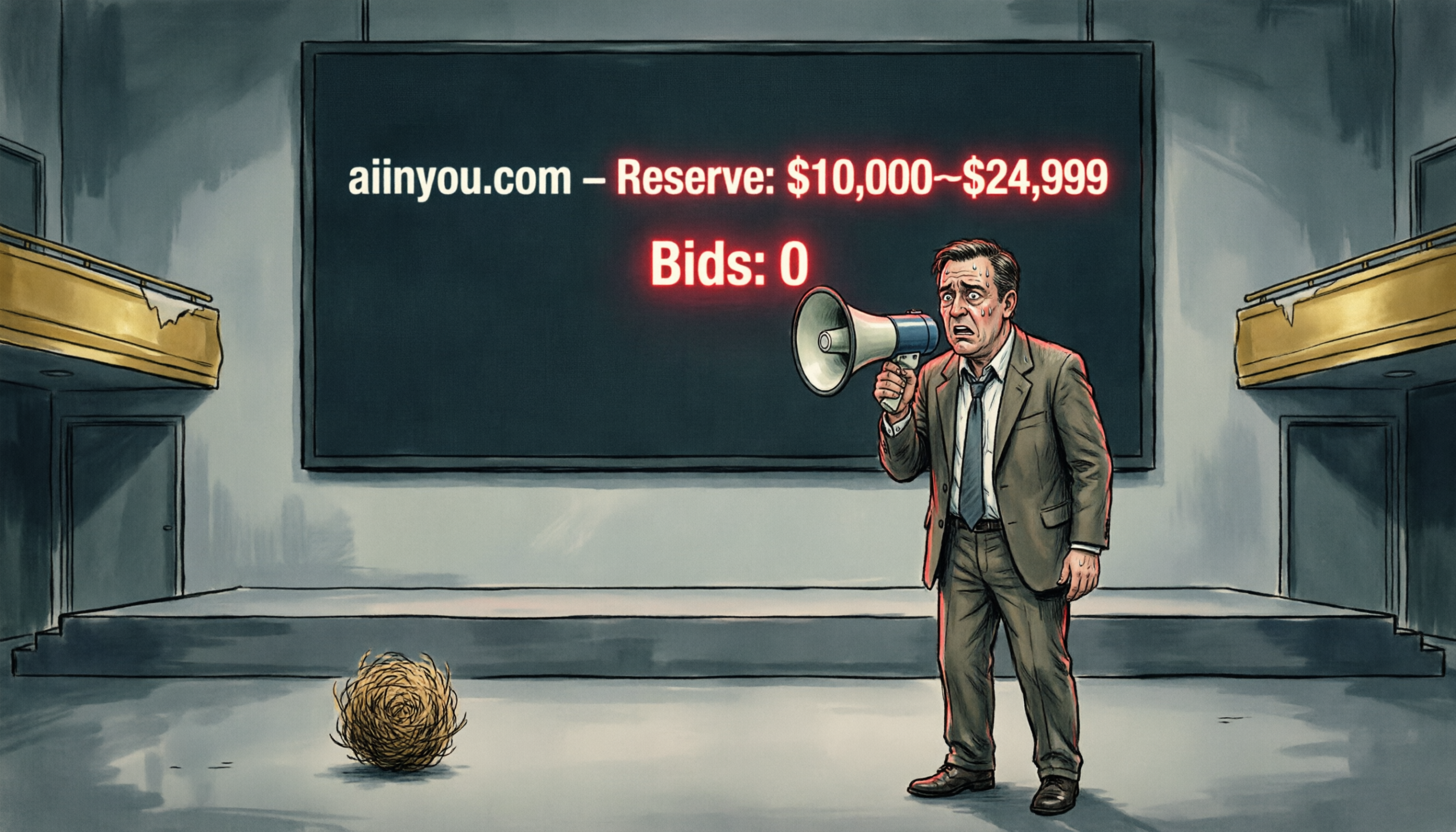
  • aiinyou.com – A Domain That Sounds Like a Bad Pickup Line, Priced Like a Luxury Car

    aiinyou.com – A Domain That Sounds Like a Bad Pickup Line, Priced Like a Luxury Car

    There is a special kind of tragedy in watching an experienced domainer make a rookie mistake. This week, Defequer discovered a Sedo auction that perfectly captures that tragedy.

    The domain: aiinyou.com. The seller: based in the United States, active in domaining since 2007. That is 19 years of experience. Nineteen years of watching the market, studying sales, learning what works. And yet, here they are, listing a domain that sounds like a rejected Tinder opener.

    The seller paid the Sedo auction fee (minimum $59) to publicize this gem. They set a reserve price range of **$10,000 – $24,999**. The auction has received zero bids.

    Let us examine why nearly two decades of domain experience couldn’t save this train wreck – and why “AI in you” is not the flex the seller thinks it is.

    aiinyou

    The Name – “AI in You”? Really?

    Let us start with the obvious: aiinyou.com is awkward. Very awkward.

    Read it aloud: “A-I in you.” Or “Ain you.” Or “Eye in you.” The pronunciation is unclear, which is already a branding death sentence. A domain that people can’t confidently say out loud is a domain that people won’t remember.

    But the real problem is the meaning – or rather, the lack thereof. What does “AI in you” even mean? Is it a reference to AI being inside you? That sounds vaguely dystopian, like a sci‑fi horror movie about sentient chatbots taking over human bodies. Is it a play on “I in you”? That sounds romantic, but also grammatically broken. Is it meant to be “AI in U” (as in “you”)? That would be aiinyou.com, which is not what they registered.

    The domain aiinyou.com tries to combine “AI” (trendy) with “in you” (vaguely personal) and ends up with something that is neither professional nor memorable. It sits in an uncanny valley between tech and cringe. No serious AI company wants a domain that sounds like a pickup line. No serious investor wants a domain that requires a five‑minute explanation.

    Compare this to actual premium AI domains: You.ai sold for $700,000 – a short, clean, grammatically correct domain that actually means something. `Bot.ai` sold for $1.2 million. Fin.ai sold for $1 million. Those are real words. Real brands. Real value.

    aiinyou.com is not you.ai. It is not even you.ai’s ugly cousin. It is a domain that a 19‑year veteran should have known better than to register.

    The Seller – 19 Years of Experience, Zero Self‑Awareness

    The seller has been in domaining since 2007. That is a long time. They have seen the rise of .com, the fall of .biz, the boom of .io, and the explosion of .ai. They have watched countless domains sell for millions. They have presumably learned something along the way.

    And yet, here they are, listing aiinyou.com for five figures.

    This is the kind of domain that a beginner registers in their first week – excited by the “AI” buzzword, oblivious to the awkward phrasing, convinced that any domain with “AI” in it is worth money. But a 19‑year veteran? They should know better.

    The saddest part is that the seller paid for this auction. They invested real money – at least $59, possibly more – to list a domain that no one wants. They set a reserve of $10,000‑$24,999, presumably believing that someone, somewhere, would see value in “AI in you.” That is not experience talking. That is desperation.

    Perhaps the seller is suffering from sunk cost fallacy. Perhaps they registered this domain years ago, paid renewal fees, and now refuse to admit it was a mistake. Perhaps they are hoping for a miracle. But after 19 years, they should know that miracles don’t happen in the domain aftermarket – at least not for domains that sound like bad poetry.

    The Price – $10k‑$25k for What, Exactly?

    Let us talk about the number. The seller set a reserve of $10,000 – $24,999. That means the auction won’t close unless someone bids at least $10,000. And what has happened? Zero bids.

    Why? Because $10,000 buys a lot in the domain market. It buys a genuinely strong two‑word .com with commercial intent. It buys a portfolio of 10‑20 solid brandables. It buys a domain that actually makes sense.

    What it does not buy is a clunky, awkward, vaguely creepy domain that no one can pronounce. aiinyou.com is worth, at best, $100‑$500 as a novelty. An end‑user might stretch to $1,000 if they have a very specific (and questionable) brand idea. But $10,000? That is not a price. That is a prayer.

    The seller appears to have looked at the .ai gold rush – where You.ai sold for $700,000, `Bot.ai` for $1.2 million, Fin.ai for $1 million – and thought, “I’ll take a piece of that.” But they missed the crucial detail: those domains are short, clean, and meaningful. aiinyou.com is none of those things.

    It is like watching someone try to sell a used bicycle for the price of a Ferrari, just because both have wheels.

    The Auction – A Ghost Town with a $59 Entry Fee

    The seller paid the Sedo auction fee – minimum $59, possibly more for premium placement. They set up the listing, wrote a description (probably full of buzzwords), and waited for the bids to roll in.

    They didn’t.

    The auction has zero bids. Not one. Not even a lowball offer from a domainer looking for a bargain. The complete radio silence tells you everything you need to know: the market has spoken, and the market is not interested.

    Sedo is one of the largest domain marketplaces in the world. It has millions of users. If aiinyou.com were a genuine bargain at $10,000, someone would have bid by now. Even a “LOL no” in the comments would be something. But there is nothing. Just silence. And that silence is deafening.

    The seller wasted their auction fee. They could have spent that $59 on a nice dinner, a domain report, or literally anything else. Instead, they burned it on a listing that will expire with no bids, leaving them with a domain they will have to renew (again) and a bruised ego.

    The “AI” Bandwagon – Jumping Late and Landing Hard

    The .ai gold rush has been one of the most significant trends in domain investing over the past few years. Short, meaningful .ai domains have sold for millions. But the gold rush is also a trap – because it convinces inexperienced (and apparently some experienced) investors that any domain with “AI” in it is valuable.

    aiinyou.com is a classic example of this trap. The seller saw the success of You.ai and thought, “I’ll register something similar!” But they missed the nuance. You.ai works because it is short, clean, and grammatically correct. aiinyou.com is a mouthful. It is confusing. It is not brandable.

    The AI gold rush is over for mediocre domains. The market has matured. Buyers are discerning. They want short, memorable, professional names – not awkward phrases that sound like a robot trying to flirt.

    The Bottom Line – A Domain That Should Have Stayed Unregistered

    aiinyou.com is not the worst domain we have ever seen. It has a certain quirky, almost poetic quality. But it is not a $10,000 domain. It is not a $5,000 domain. It is a novelty at best, a liability at worst.

    The seller, with 19 years of experience, should have known better. They should have let this one go. They should have saved their auction fee and their renewal costs. Instead, they doubled down on a bad decision, and now they have a public record of a failed auction to show for it.

    If the seller is reading this, we have a suggestion: let it drop. Cut your losses. Save your renewal fees. Use the money to buy a domain that doesn’t sound like a bad pickup line. Or don’t. But do not say we did not warn you.

    Defequer Rating: 💩💩💩💩 (4/5 shits)

    Four shits. Not five, because the domain is merely awkward (not trademark‑infringing or gibberish). But the $10,000‑$24,999 reserve, the zero bids, the wasted auction fee, and the 19 years of experience that apparently taught the seller nothing earn a solid four. The Delusion Olympics – Veteran Division – has a new medalist.

    Roast served. Auction mocked. Next delusion, please.

    Post‑Roast Note to the Seller

    Dear veteran domainer of 2007,

    We have a question: what were you thinking?

    You have been in this business for 19 years. You have seen the rise and fall of countless domain trends. You have watched the .ai gold rush from the sidelines. And you chose to register aiinyou.com?

    aiinyou.com is not a brand. It is not a domain. It is a cry for help. It sounds like a robot trying to flirt. It sounds like a rejected tagline for a dating app. It sounds like something a beginner registers in their first week, not something a 19‑year veteran pays an auction fee for.

    Here is our advice, offered free of charge (unlike your auction listing):

    1. Cancel the auction (if possible) or let it expire. Do not renew it.
    2. Do not renew aiinyou.com next year. Let it drop.
    3. Next time, ask yourself: “Would a real business pay real money for this name?” If the answer is “maybe, if they want to sound like a bad pickup line,” do not register it.

    You have 19 years of experience. That is a valuable asset. Do not waste it on domains that belong in the bargain bin.

    We will be here. Watching. And hoping your next domain is better than this one.

  • llmmarketagent.com – A 1‑Month‑Old Domain, a $50k Reserve, and Zero Bids

    llmmarketagent.com – A 1‑Month‑Old Domain, a $50k Reserve, and Zero Bids

    The AI gold rush has produced some remarkable domain sales. It has also produced a staggering amount of garbage – domains that consist of trendy acronyms glued together, priced as if the AI itself will magically transfer value into the seller‘s wallet.

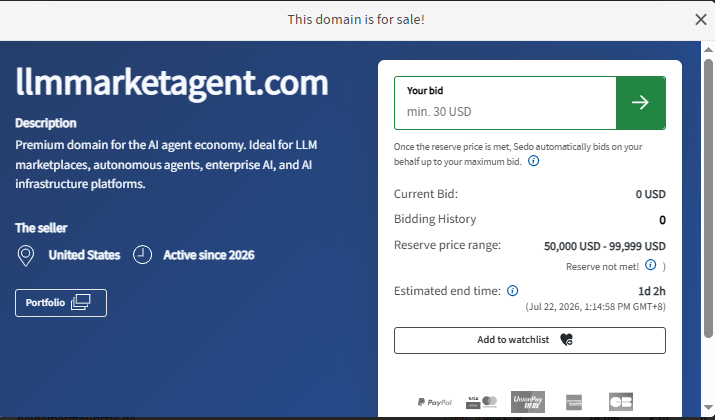
    This week, Defequer found a prime specimen on Sedo. The domain: llmmarketagent.com. The format: a Sedo auction. The reserve price range: $50,000 – $99,999. The bids received: zero. The seller: based in the USA, active in domaining since 2026 (that is this year). The registration date: 22 June 2026.

    Let us do the maths. As of this writing (late July 2026), this domain is approximately one month old. One month. Thirty‑one days. The seller has owned it for less time than it takes to form a habit.

    And they want at least $50,000 for it.

    The seller‘s description reads: “Premium domain for the AI agent economy. Ideal for LLM marketplaces, autonomous agents, enterprise AI, and AI infrastructure platforms.”

    Let us translate that from Buzzword to English: “I registered a 20‑character string that contains ‘LLM,’ ‘market,’ and ‘agent’ – three trendy AI terms – and I am hoping some AI startup with more funding than sense will buy it.”

    Spoiler alert: they will not.

    Let us roast this overpriced AI word salad from every angle – the name, the price, the age, the seller‘s inexperience, and the auction that nobody wants.


    The Name – A 20‑Character Mouthful That Means Nothing

    Let us break down llmmarketagent.com:

    • “LLM” – Large Language Model. This is a real AI term. It refers to models like GPT‑4, Claude, and Gemini. It is a trendy acronym.
    • “Market” – As in marketplace, or marketing, or market analysis. A common word.
    • “Agent” – As in AI agent, autonomous agent, or software agent. Another trendy AI term.

    Put them together and you get llmmarketagent. That is 14 characters (not counting the .com). It is long. It is clunky. It is not memorable. And it does not roll off the tongue.

    Try saying it out loud: “El‑Ell‑Em market agent.” It sounds like a robot with a speech impediment. Compare this to genuinely premium AI domains: Wisdom.ai (sold for $750,000), `Coach.ai` (sold for $300,000), or even Agent.ai (which is short, memorable, and actually means something). llmmarketagent.com is not in their league.

    The domain is also highly specific in a way that limits its appeal. “LLM market agent” could refer to an agent that operates in an LLM marketplace – but that is a very narrow niche. A company building a general‑purpose AI agent would not want “LLM” in their name. A company building an LLM marketplace would not want “agent” in their name. The domain tries to cover too many bases and ends up covering none.

    This is not a premium domain. It is a keyword salad with a side of FOMO.


    The Price – $50k–$99k for a 1‑Month‑Old .com

    Let us talk numbers. The seller has set a reserve price range of $50,000 to $99,999. That means the auction will not close unless someone bids at least $50,000. And what has happened? Zero bids. Not one. Not even a lowball offer. The auction is a ghost town.

    Why? Because no rational buyer pays $50,000 for a domain that:

    • Is lengthy and mouthful
    • Was registered one month ago
    • Has no web presence, no traffic, no backlinks
    • Is not a dictionary word or a recognizable brand
    • Has a pitch that reads like a LinkedIn influencer‘s fever dream

    What does $50,000 buy in the real domain market? A genuinely strong two‑word .com with commercial intent. A portfolio of 10–20 solid brandables. A meaningful marketing campaign. What it does not buy is a clunky, 14‑character, one‑month‑old domain that no one has heard of.

    The seller appears to have watched the AI domain gold rush and thought, “I‘ll just grab any random string that contains ‘LLM’ and ask for six figures.” That is not domain investing. That is throwing darts blindfolded and hoping for a bullseye.


    The Age – Registered Yesterday (Literally)

    The domain was registered on 22 June 2026. As of late July 2026, it is approximately one month old. That is not aged. That is a newborn. The seller cannot claim any SEO benefits, historical authority, or legacy value. There is no backlink profile to speak of. There is no content archive. There is nothing except a registration receipt and a dream.

    Compare this to genuinely valuable domains, which often have years of continuous registration, development, or at least a clear brand narrative. llmmarketagent.com has none of that. It is a fresh registration with a trendy acronym. The only thing “premium” about it is the seller‘s imagination.

    If the seller had registered this domain in 2019 and held it continuously, built content around it, or developed a brand, then a high price might be arguable (though still not $50k). But a June 2026 registration? That is a hand‑reg like millions of others. The only difference is the seller‘s ambition – which is not a marketable asset.


    The Seller – A 2026 Newcomer with Big Dreams and No Data

    Sedo shows that the seller started domaining in 2026. That means they have been in the business for approximately one month (assuming this is late July 2026). One month. And already they are running auctions with $50,000 reserves.

    There is nothing wrong with being a beginner. Every expert was once a novice. But beginners who succeed in domain investing do their homework. They study comparable sales. They learn what makes a domain valuable (length, extension, keyword strength, brandability, age, traffic). And they price realistically.

    This seller appears to have skipped all of that. They registered a 14‑character domain with a trendy acronym, listed it on Sedo, set a $50,000 reserve, and hoped for a miracle. That is not investing. That is gambling on ignorance.

    We would advise the seller to spend the next month – and the months after that – reading NameBio, following domain market reports, and learning what actual premiums look like. Wisdom.ai sold for $750,000. llmmarketagent.com is not Wisdom.ai. It is not even WisdomAgent.com. It is a reminder that not all domains are created equal, and not all dreams are achievable.


    The Buzzword Pitch – A Masterclass in Meaningless Hype

    The seller‘s description deserves a closer reading, because it is a textbook example of using trendy jargon to mask the absence of value.

    “Premium domain for the AI agent economy. Ideal for LLM marketplaces, autonomous agents, enterprise AI, and AI infrastructure platforms.”

    Let us identify the empty calories in this sentence:

    • “AI agent economy” – This is a buzzword, not a defined market. It sounds impressive, but what does it actually mean? Nobody knows.
    • “LLM marketplaces” – There are a few LLM marketplaces (like the OpenAI API marketplace), but they are niche. And they do not need a 14‑character domain to succeed.
    • “Autonomous agents” – Yes, autonomous agents are a real thing. But the domain does not help with autonomous agents. It just contains the word “agent.”
    • “Enterprise AI” – Another buzzword. Enterprise AI companies prefer short, professional names like DataRobot.com or C3.ai. Not llmmarketagent.com.
    • “AI infrastructure platforms” – Again, a real category. But infrastructure platforms use names like WeightsAndBiases.com or HuggingFace.co. Not llmmarketagent.com.

    The pitch is all signifiers and no substance. It is like saying BlueCar.com is “the premium domain for the automotive mobility economy, ideal for electric vehicle platforms, autonomous driving solutions, and shared transport ecosystems.” No. BlueCar.com is a domain. The rest is noise.

    If the seller genuinely believed in this domain, they would have built a landing page explaining the brand. They would have developed content. They would have done something – anything – to demonstrate value. Instead, they paid for a Sedo auction and hoped for a miracle.


    The Auction – A Ghost Town

    The seller chose a Sedo auction with a reserve of $50,000–$99,999. The auction has received zero bids. That is not a failure of marketing. That is a failure of pricing.

    Sedo is one of the largest domain marketplaces in the world. It has millions of users. If llmmarketagent.com were a genuine bargain at $50,000, someone would have bid by now. Even a lowball bid. Even a “LOL no” in the comments. The complete radio silence tells you everything you need to know: the market has spoken, and the market is not interested.

    The seller will likely keep the auction running, hoping that someone – anyone – will bid. But they will be disappointed. Because the domain is not worth $50,000. It is not worth $5,000. It is worth a fraction of that.


    The Bottom Line – A Domain That Should Be Left in the AI Graveyard

    llmmarketagent.com is not a premium domain. It is not even a mediocre domain. It is a 14‑character, one‑month‑old, buzzword‑heavy string that no serious business would want. Its only claim to relevance is that it contains “LLM,” “market,” and “agent” – three trendy AI terms. And that claim is worth approximately zero dollars.

    The seller‘s pitch is pure buzzword salad, designed to impress people who do not understand domain valuation but do understand that AI sounds futuristic. Unfortunately for the seller, the only people impressed by buzzwords are other beginners. Serious buyers look at the name itself. And the name itself is a mess.

    The auction has zero bids. It will likely close with zero bids. The domain will sit unsold, renewed year after year, until the seller finally gives up or the registrar deletes it for non‑payment. That is the future of llmmarketagent.com. Not a $50,000 payday. Not an “AI agent economy” empire. Just a quiet, inglorious expiration.

    If the seller is reading this, we have a suggestion: drop the domain. Save your renewal fees. Use the money to buy a domain that actually means something. Or don‘t. But do not say we did not warn you.


    Defequer Rating: 💩💩💩💩💩 (5/5 shits)

    Five shits. This domain earns the maximum rating for the perfect storm of one‑month‑old registration, 14‑character clunkiness, buzzword pitch, $50,000 reserve, zero bids, and a seller who started domaining in 2026. The AI gold rush has produced some legitimate successes, but llmmarketagent.com is not one of them. It is a cautionary tale about what happens when hype replaces homework. The Delusion Olympics have a new medalist.

    Roast served. Auction mocked. Next delusion, please.


    Post‑Roast Note to the Seller

    Dear US‑based domainer who joined in 2026,

    Welcome to domaining. We hope you are enjoying your first month. But we need to have a serious conversation about llmmarketagent.com.

    You registered this domain on 22 June 2026. It is now late July 2026. You have owned it for approximately one month. And you are asking for $50,000. That is not a business strategy. That is a lottery ticket.

    We are not saying this to be cruel. We are saying it because you are clearly enthusiastic, and enthusiasm is valuable – but only when paired with education.

    Here is what you should do next:

    1. Cancel the auction (if possible) or let it expire. Do not renew it.
    2. Do not renew llmmarketagent.com next year. Let it drop.
    3. Spend the next three months studying domain sales. Look at what actually sells for $50,000 (hint: one‑word .coms, ultra‑premium brands, established traffic domains). Compare those to your domain. Note the differences.
    4. Start small. Register domains that are short, memorable, and commercially relevant. List them at prices between $500 and $5,000. Learn what works.
    5. Never write a pitch like that again. Buzzwords do not create value. They just make you look like you do not know what you are talking about.

    You have potential. But potential without data is just wishful thinking. Put in the work. The results will follow.

    We will be here. Watching. And hoping your next domain is better than this one.

  • Fermmade.com – The $800,000 Misspelling That Wants to Disrupt Your Dinner

    Fermmade.com – The $800,000 Misspelling That Wants to Disrupt Your Dinner

    Fresh off the digital slaughterhouse, Defequer has found its next victim. This time, we are leaving the world of patent delusions and palindrome disasters to enter the fragrant, bubbly universe of precision fermentation.

    Yes, you read that correctly. Precision fermentation—the process of using microbes to brew proteins and fats—is apparently the next big thing. And one Bulgarian domainer, who started in 2025 (barely a year ago), has decided that the key to owning this $36 billion market is a misspelled, awkward, 8-character domain that sounds like a bad pun on “farm made.”

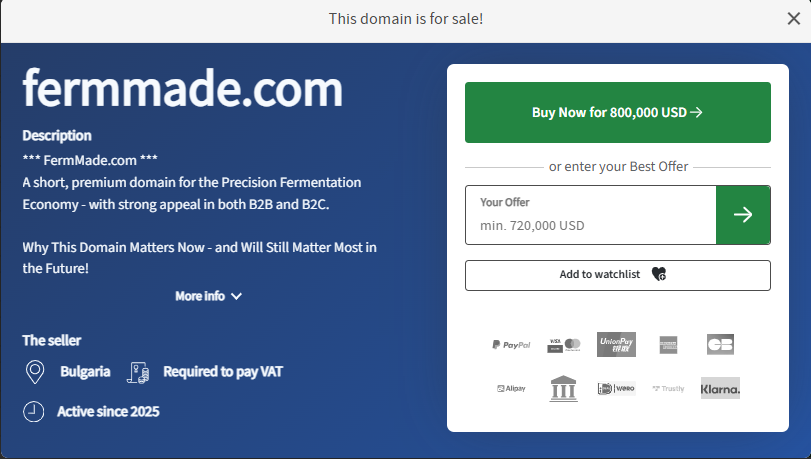
    Meet fermmade.com. Registered on 4 May 2026—that’s approximately five weeks ago as of this writing—and already listed on Sedo with a BUY-IT-NOW price of $800,000.

    The seller, based in Bulgaria and active since 2025, has written a pitch that is longer than the domain’s entire existence. It cites funded companies, market reports, and the importance of “emotional resonance.” It speaks of “storytelling-driven .com domains” and “cutting-edge science.”

    It is, in short, a beautifully constructed house of cards built on a foundation of wet cardboard.

    Let us, with the full force of Defequer’s analytical scorn, examine exactly why fermmade.com is not a premium asset for the fermentation economy—but a rookie mistake dressed in PowerPoint slides.

    Introduction – When a Typo Meets a Trend Report

    There is a specific type of domainer that emerges during every tech boom. They are not builders. They are not investors. They are keyword scavengers—people who read a single McKinsey report, spot a CAGR of 48.6%, and immediately rush to their registrar to hand‑register every plausible-sounding combination of the hot new buzzword.

    Precision fermentation is the hot new buzzword of 2026. It is real. It is growing. It may very well change how we produce protein. But here is the thing that the keyword scavengers consistently fail to understand: a trendy industry does not automatically make every domain containing a related word valuable.

    fermmade.com is the perfect example. The seller saw the word “ferm” (industry shorthand for fermentation) and thought, “What if I add ‘made’? Fermmade! It’s like handmade, but for microbes!”

    What they actually created is a domain that is:

    • Misspelled (two ‘m’s in a row? Really?)
    • Confusable with “farm made” (which is the exact opposite of precision fermentation)
    • Registered for less time than it takes to brew a decent sourdough starter
    • Priced at nearly a million dollars

    The market for precision fermentation ingredients is projected to reach $36 billion by 2030. The market for `fermmade.com` is precisely $0. Let us explain why.

    The Backstory – From Bulgarian Rookie to “Premium” Seller in 12 Months

    Who Is the Seller? (a.k.a. The Trend Chaser)

    According to Sedo, the seller is based in Bulgaria and has been domaining since 2025. As of June 2026, that means they have roughly one year of experience. One year.

    This is not a veteran who survived the .com crash. This is not a portfolio manager with a track record of six‑figure sales. This is someone who discovered the concept of hand registration sometime last year, read a few NamePros threads, and decided that the path to riches was to find a trending keyword and squat on it.

    The seller’s pitch is eloquent—almost too eloquent. It cites Cauldron Ferm (raised $13.25M) and FermBase (launched January 2026 by CREMER Group). It quotes MarketsandMarkets (May 2025) with a 48.6% CAGR. It talks about “emotional resonance” and “storytelling-driven .com domains.”

    This is the classic sign of a rookie who has done their homework on the industry but has done absolutely no homework on the domain aftermarket. They have convinced themselves that because precision fermentation is hot, any domain with “ferm” in it is a goldmine. They are wrong.

    The Registration Date – Fresh Out of the Digital Oven

    The WHOIS record shows that fermmade.com was registered on 4 May 2026.

    Let me do the math for you. Today is 9 June 2026. That means this domain has been alive for 36 days. Five weeks. Less time than it takes to get a refund from an online retailer.

    The seller paid the registrar roughly $10–$15 for a standard .com registration. They then waited just over a month—during which the domain generated exactly zero traffic, zero backlinks, and zero brand recognition—and decided that this digital infant was worth $800,000.

    To put that in perspective: if you had bought fermmade.com on 4 May and left it in a drawer, it would still be in its first month of life. And the seller is asking for nearly a million dollars.

    Under normal marketplace conditions, a 36‑day‑old, never‑developed, hand‑registered .com with no existing business, no trademarks, and no traffic is worth exactly $10–$50 in a firesale. $800,000 is not a price. It is a cry for help.

    The Domain Autopsy – Why fermmade.com Is a Fermentation Failure

    Length – 8 Characters (Actually Not Bad, But Wait)

    Let us get the counting right. When calculating domain length, we DO NOT count the extension (.com). We count only the characters on the left side of the dot.

    Spell it out: F E R M M A D E

    • F E R M = 4 letters
    • M A D E = 4 letters
    • Total = 8 characters.

    So the domain fermmade.com is 8 characters long.

    On the surface, 8 characters is good. It is short. It is easy to type. But length is only one variable. And here, the brandability, the spelling, and the market fit are all catastrophic.

    Brandability – The Double‑M Disaster

    Let us start with the most obvious problem: the spelling.

    fermmade contains two consecutive ‘m’s: “ferm” + “made” = “fermmade.” When you look at it, your brain does one of two things:

    1. It sees farm made – because “farm” is a common word, and “ferm” is not. The visual similarity is striking. And if a potential customer types farmmade.com by accident, they go to a different domain.
    2. It sees ferm made – and wonders if the second ‘m’ is a typo. Is it ferm‑made with a hyphen? Is it ferm_made? The double consonant is awkward and un‑English.

    The seller’s pitch claims that “Ferm is active industry shorthand.” That is true—within the tiny, niche world of precision fermentation scientists and investors. But to the other 7.9 billion people on the planet, “ferm” means nothing. It sounds like “firm” with a lisp. It sounds like a typo for “farm.”

    A premium domain does not require an industry glossary to decode it. Milk.com needs no explanation. Protein.com is obvious. Fermmade.com needs a 500‑word pitch to justify its existence. That is not a premium asset. That is a liability.

    The “Made” Problem – Warm, Fuzzy, and Completely Wrong

    The seller writes that FermMade.com “conveys simplicity, positivity, warmth, and authenticity.” They contrast it with names that are “cold, industrial, or purely functional.”

    Here is the problem: precision fermentation is industrial. It is tanks, microbes, and bioreactors. It is science. The successful brands in this space—Perfect Day, Clara Foods, The EVERY Company—use names that are either abstract, descriptive of the end product (dairy, eggs), or whimsical. They do not use “made” as a suffix because “made” implies artisanal, small‑batch, handmade.

    Precision fermentation is the opposite of handmade. It is precision‑made. It is factory‑made. Fermmade sounds like a farmer’s market stall selling kombucha, not a $36 billion industrial protein revolution.

    The seller has confused “emotional resonance” with “misleading branding.” A B2B buyer looking for fermentation‑derived ingredients does not want warmth. They want reliability, scalability, and technical specs. A B2C consumer does not know what “ferm” means. The domain fails both audiences.

    The Pitch Deconstruction – A Masterclass in Over‑Selling

    The seller wrote a pitch that is, on its face, impressive. But let us read between the lines.

    *”A short, premium domain for the Precision Fermentation Economy – with strong appeal in both B2B and B2C.”*

    Translation: I registered this 36 days ago and I am already calling it “premium.”

    *”Ferm is active industry shorthand – used by funded companies like Cauldron Ferm ($13.25M raised, Fast Company 2026), and FermBase (launched January 2026 by CREMER Group).”*

    Translation: I read a report. That report does not mention my domain. The size of the market has nothing to do with the value of a hand‑registered typo.

    “Innovative, meaningful, and storytelling-driven ‘Ferm’ .com domains are rare. FermMade.com is one of them.”

    Translation: I made up the category “storytelling-driven Ferm domains” to make mine look special. There are no comparable sales because nobody is stupid enough to pay for this.

    “Where other names may feel cold, industrial, or purely functional, FermMade.com combines cutting-edge science with emotional resonance.”

    Translation: I have never spoken to an actual B2B buyer in the fermentation industry.

    The pitch is beautiful. The domain is not.

    Comparable Sales – The Data That Destroys the Dream

    Let us ground ourselves in actual market data. The seller is asking $800,000. What do real domains in the food/ag/fermentation space actually sell for?

    • Fermentation.com – If this domain ever sold, it would be a six‑figure name. It is the exact dictionary word. fermmade is not.
    • CulturedFood.com – A clear, descriptive, two‑word .com. Estimated value: low five figures.
    • PlantBased.com – A category‑defining name. Sold for mid six figures after years of development and traffic.

    The median .com sale price on Sedo in 2025 was **$595**. The median domain in the “food and beverage” category sells for under $2,000. For $800,000, you could buy:

    • A portfolio of 1,000 decent hand‑reg domains
    • A small restaurant
    • A used Ferrari
    • It.com (which sold for $3.8 million – actually cheaper per letter)

    Fermmade.com is not worth 0.1% of that. It is worth the registration fee: $10.

    The Defequer Delusion Index (DDI)

    We rate domains on a 1–10 scale of pure, unapologetic delusion.

    • 1–3 – Optimistic but harmless.
    • 4–6 – Overpriced by a factor of 10.
    • 7–9 – Hall of Fame delusion.
    • 10 – a random selling claiming to own sex.com and pricing it at $1 trillion.

    fermmade.com scores a 9.0 / 10.

    Why 9? Because the seller at least did some research on the industry. But the combination of:

    • A 36‑day‑old registration (literally brand new)
    • A rookie seller with one year of experience
    • A misspelled, awkward double‑m domain
    • A $800,000 price tag that is 80,000x the registration cost
    • A pitch that confuses market size with domain value

    …makes this one of the most confidently wrong listings we have seen. The seller is not selling a domain. They are selling a dream. Unfortunately, dreams are not a recognized currency on Sedo.

    A Satirical Open Letter to the Bulgarian Rookie

    Dear 2025 Bulgarian domainer,

    You have written a beautiful pitch. Seriously. It is well‑researched, emotionally resonant, and almost persuasive. If you were selling a business plan for a precision fermentation startup, I would be impressed.

    But you are not selling a business. You are selling a domain. A domain that you registered five weeks ago. A domain that has two ‘m’s in a row and looks like a typo for “farm made.” A domain that you are asking eight hundred thousand dollars for.

    I want you to imagine something. Imagine you are a venture capitalist who just invested $13 million in Cauldron Ferm. You are looking for a domain for your next spin‑off. You see fermmade.com. You squint. You type it slowly. You think, “Is this a typo?” Then you check the WHOIS and see it was registered last month. Then you laugh. Then you close the tab.

    That is the future of your $800,000 listing.

    Lower the price. Drop it to $500 and market it to a kombucha blogger. Or, better yet, let it expire and register `fermentationmadeeasy.com` for $10. You have a long career ahead of you. Do not let a 36‑day‑old hand‑reg be your white whale.

    With love and a free lesson in brandability,

    Defequer

    Final Verdict – The Shortest Chapter Heading

    Summary of Shame

    • Asset Quality: Poor. 8 characters is fine, but the double‑m spelling is awkward, confusable with “farm made,” and requires a glossary to understand.
    • Price Sanity: None. Comparable food/ag domains sell for low four figures. $800,000 is delusional.
    • Seller Experience Paradox: One year in domaining, yet confident enough to ask nearly a million for a 35‑day‑old hand‑reg.
    • Actual Market Value: $10–$50. Possibly $500 to a very naive end‑user.
    • Likelihood of $800k Sale: 0.0000001%

    Defequer Rating

    💩💩💩💩 (4/5 Shits)

    “Not a 5‑shit masterpiece because the seller actually did some research. But the combination of a 36‑day‑old registration, a rookie Bulgarian seller, a misspelled double‑m domain, and an $800,000 price tag based on a market report is a textbook case of ‘I read a CAGR and lost my mind.’ The Defequer recommendation: let it expire and register precisionfermentationdomainsarenotautomaticgoldmines.com – at least that would be honest.”

  • Neuwagen1.de: The Generic “New Car 1” Domain with a €25,000–€49,999 Reserve That No One Wants

    Neuwagen1.de: The Generic “New Car 1” Domain with a €25,000–€49,999 Reserve That No One Wants

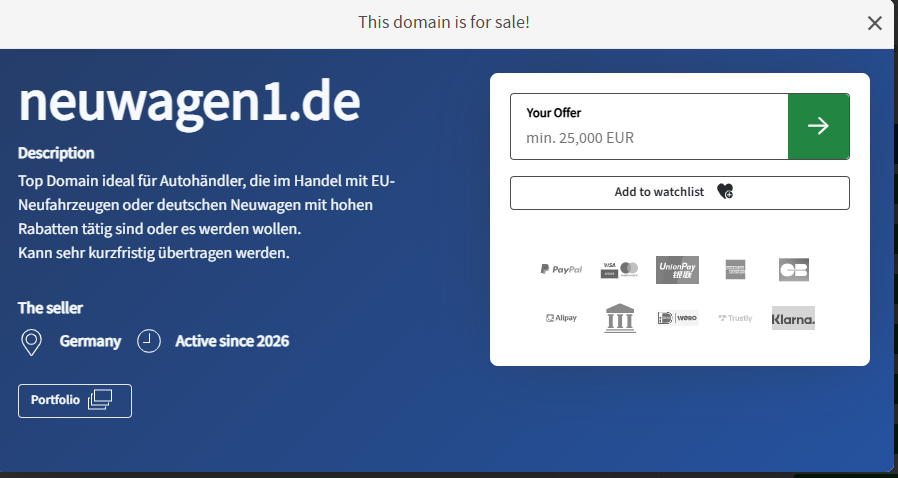
    In Germany’s strong .de market, some new sellers still believe that a highly descriptive name combined with a big reserve equals instant premium value. Enter Neuwagen1.de — currently sitting in a Sedo auction with a reserve range of €25,000 to €49,999.

    The seller, based in Germany and apparently new to Sedo in 2026, wrote an enthusiastic pitch positioning it as the perfect domain for car dealers trading in EU new vehicles or German “Neuwagen” with high discounts. The domain can be transferred quickly, they promise.

    The market’s response so far? Complete silence. Not a single bid.

    This is what happens when someone confuses a literal keyword description with a strong brand.

    The Contender in the Spotlight

    The seller’s pitch is straightforward and optimistic:

    “Top Domain ideal für Autohändler, die im Handel mit EU-Neufahrzeugen oder deutschen Neuwagen mit hohen Rabatten tätig sind oder es werden wollen. Kann sehr kurzfristig übertragen werden.”

    They clearly believe “Neuwagen1” is a ready-made asset for the German new car market. The reserve is set high enough to guarantee that only very serious buyers will even consider it — and so far, none have shown up.

    The listing uses Sedo’s standard auction format, but the ambitious reserve range has effectively priced out almost everyone from the start.

    The Backstory: A Brand-New Seller’s Big First Swing

    The domain is very recently registered (2025/2026), and the seller appears to be a newcomer to Sedo. This looks like their opening move: register a descriptive German keyword domain and immediately go for a five-figure reserve, hoping the strong .de extension and local relevance will carry the value.

    This is classic new-seller behavior — high expectations, low market calibration. They see the German car market (one of the strongest in Europe) and assume “New Car 1” must be valuable without considering branding fundamentals.

    Breaking Down the Domain Quality: Too Literal, Too Generic

    Let’s be direct about the name:

    • Neuwagen1.de translates directly to “New Car 1” in German. It is extremely descriptive and functional, but that’s the problem.
    • The “1” suffix makes it feel like the first draft of a domain idea rather than a premium brand. It screams “placeholder” or “directory site.”
    • In the highly competitive German automotive market, successful brands are memorable, short, and emotionally appealing (think Mobile.de, Autoscout24, Sixt, or even strong regional names). “Neuwagen1” feels like a basic SEO keyword page, not a brand people want to trust with large purchases.
    • While .de is a strong extension in Germany, it cannot overcome a name that lacks creativity and distinctiveness. The domain is long, clunky, and instantly forgettable.

    This is the domain equivalent of naming your car dealership “CarsForSaleNumber1.”

    The Delusion Factor: New Seller Syndrome at Full Throttle

    The seller’s enthusiasm is understandable — they see a big local market and a descriptive name and assume it must be worth five figures. But this is textbook new-seller delusion: overestimating the value of literal keywords while underestimating what actual buyers want (strong, brandable names).

    Setting a €25,000+ reserve on a very new, generic descriptive domain shows a complete disconnect from current aftermarket realities in the German market. Even good .de domains in the auto space rarely command that kind of money unless they are short, premium, and have proven demand.

    Realistic Valuation: What the Zero Bids Are Saying

    In the German .de aftermarket, strong automotive domains can do well, but highly descriptive, numbered names like Neuwagen1.de typically trade in the low-to-mid four figures at best. A realistic value sits somewhere between €200 – €500 on a good day with the right end-user.

    The €25,000–€49,999 reserve range is so far above market reality that it guarantees the auction will likely end with no sale. The silence is the market’s clear verdict.

    Lessons for Domainers: Descriptive ≠ Premium

    Even in strong local markets like Germany’s automotive sector, literal keyword domains with numbers rarely become premium brands. Buyers want names that feel trustworthy and memorable, not ones that sound like SEO-optimized directory pages. New sellers should study actual sales data and start with realistic expectations instead of jumping straight to five-figure reserves.

    The Defequer Verdict

    CategoryRating
    Name Quality⭐☆☆☆☆ (1/5)
    Appraisal Sanity⭐☆☆☆☆ (1/5)
    Actual Market Value⭐☆☆☆☆ (1/5)
    Likelihood of €25K+ Sale0.00%

    Defequer Rating: 💩💩💩💩💩 (5/5 shits — a brand-new seller listing “New Car 1” with a €25K+ reserve is peak optimistic delusion.)

    Neuwagen1.de isn’t completely worthless, but at this price level it’s comedy. The German car market is big, but it’s not big enough to pay five figures for “New Car Number One.”

    Got more ambitious new-seller launches, generic keyword .de domains, or any other over-hyped listings you want roasted? Drop us an email. We’re always flushing the fluff — one overly optimistic reserve at a time.

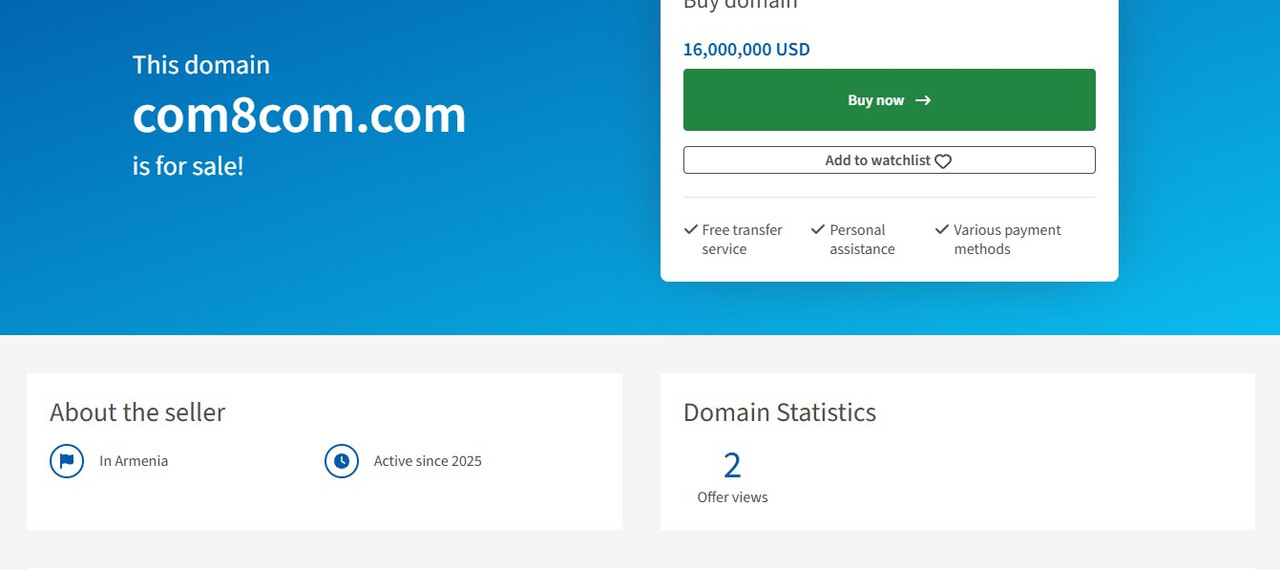
  • Com8Com.com – The $16 Million Palindrome That Doesn’t Work (And The Armenian Rookie Who Thinks It Does)

    Com8Com.com – The $16 Million Palindrome That Doesn’t Work (And The Armenian Rookie Who Thinks It Does)

    Com8Com.com isn’t just a domain; it’s a brutal Rorschach test for the human capacity for self-delusion. In the vast, chaotic bazaar of the domain aftermarket, we have seen our fair share of digital garbage listed with a premium price tag. But every so often, a listing appears that is so spectacularly misguided, so perfectly wrong in its execution, that it transcends mere delusion and becomes a work of art.

    Today, we are not looking at a domain. We are looking at a Hall of Fame candidate.

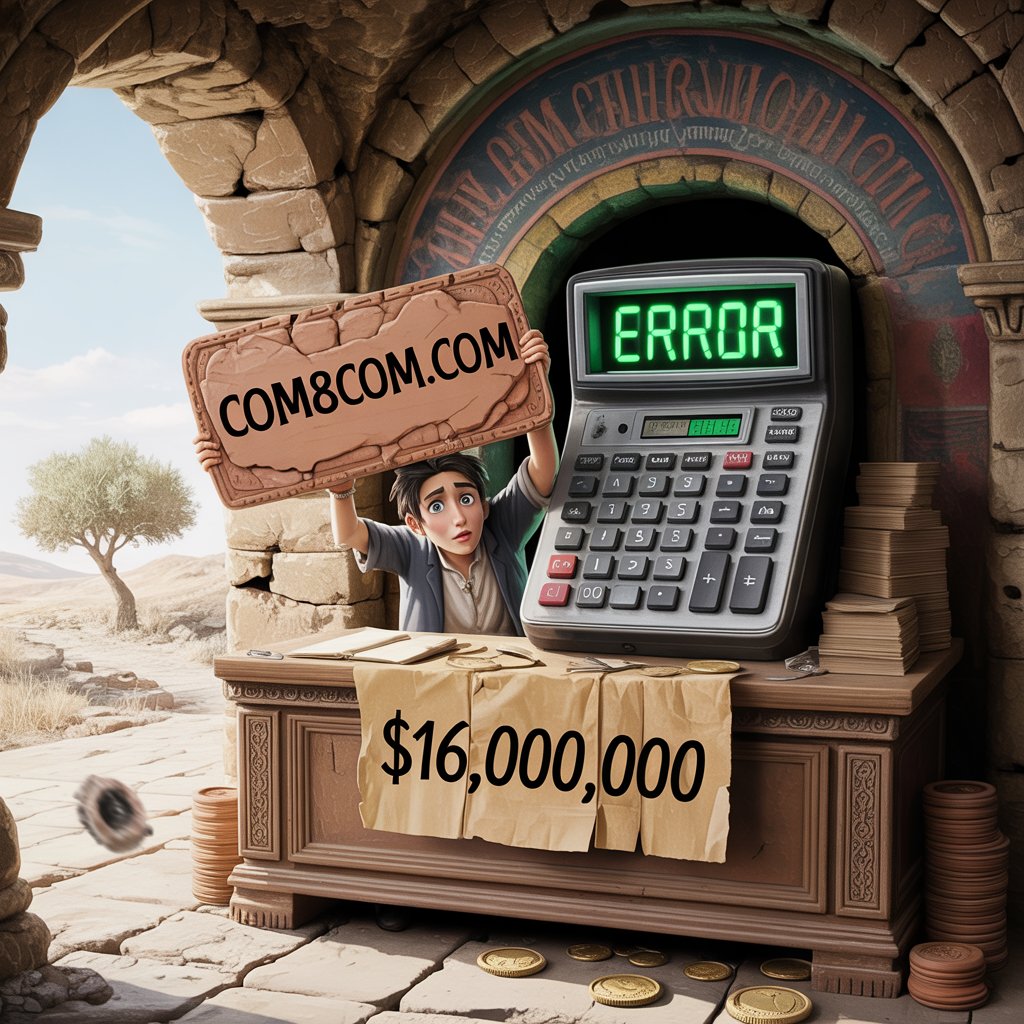
    Sit back, pour yourself a stiff drink, and join us in the Defequer pressure chamber. Because com8com.com is currently listed on Sedo for the low, low price of $16,000,000 USD.

    And we are going to tear it apart, character by character.

    Introduction – The Birth of a Trainwreck

    In the proud and unhinged ecosystem of domain flipping, nothing is as seductive—or as ruinous—as the “pattern play.” That is when an investor registers a domain that ticks a mechanical box (numeric pattern, palindrome, repetition) and convinces themselves that the mechanical trickery is worth millions. The seller thinks they have discovered a secret cheat code. The market, as it always does, responds with the quiet indifference of a cat watching a roomba fall down the stairs.

    com8com.com is the quintessential example.

    At first glance, the structure reveals itself:

    • com – The most valuable top-level domain on earth.
    • 8 – The number of infinity and prosperity.
    • com – A second helping of the most valuable TLD on earth.

    What could go wrong? A palindrome? A structural mirror? Surely, this is a winning lottery ticket.

    Let’s pull back the curtain and see what is really hiding behind that $16 million asking price. What we find is a seller with less than one year of experience, a domain that is barely six months old, and a world-class misunderstanding of what gives a digital asset its “premium” status.

    The Backstory – From Armchair to “Auction” in Under Six Months

    Who Is the Seller? (a.k.a. The Rookie Who Shot for the Moon)

    According to the Sedo listing details and platform data, the seller is located in Armenia and has been actively domaining since 2025. Let me pause to let that sink in.

    As of today (May 2026), that means this individual has been in the domain industry for roughly six months to a year.

    This is not a veteran domainer with decades of experience and a deep Rolodex of end-user buyers. This is someone who discovered the concept of “hand registration” less than 365 days ago and immediately decided to bet the farm on a palindrome that runs on fumes. In the world of high finance, this is the equivalent of buying your first lottery ticket and immediately quitting your job. Except in domain investing, the lottery ticket is a 7-character confusing mess, and the prize is the cold, hard silence of an empty Sedo notification tray.

    The Registration Date – Fresh Out of the Digital Wrapper

    The WHOIS record, meticulously examined by the Defequer forensic team, shows that this domain was registered on 18 November 2025. That is the day the seller paid the registrar roughly 10–10–15 to claim this digital real estate.

    As of May 2026, that makes com8com.com barely 6 months old.

    Let’s do the math in plain English: The seller spent the cost of a large pizza to hand-register a domain that had never been owned, never been developed, and never seen a single visitor. They then waited less time than it takes for a jar of mayonnaise to expire, and decided that this digital nothingburger was worth $16,000,000.

    Under normal marketplace conditions, a 6-month-old, never-developed, unpronounceable .com with no backlinks, no brand recognition, and no existing business is worth exactly below $100,

    The16 million price tag is not a price. It is a fever dream with a decimal point.

    The Domain Autopsy – What com8com.com Actually Is (And Why It’s Not Pretty)

    Length – The 7-Character Palindrome That Isn’t Short Enough

    Let’s get the counting right. When calculating domain length, we DO NOT count the extension (.com). We count only the characters on the left side of the dot.

    Spell it out: C O M 8 C O M

    • C O M = 3 letters
    • The number 8 = 1 character
    • C O M = 3 letters

    That gives us 3 + 1 + 3 = 7 characters.

    So the domain com8com.com is 7 characters long, excluding the ‘dot com’.

    On the surface, 7 characters is fine. It is not the 22-character trainwreck of worldlifeautobiography.com. It is short enough to type without developing carpal tunnel syndrome. It is a palindrome, meaning it reads the same forwards and backwards. That is a neat parlor trick. But length is only one variable in valuation. And here, every other variable is on fire.

    Brandability – The “COM” That Isn’t a Brand

    The seller’s logic, presumably, runs something like this: “COM is the most valuable extension. So if I put COM before and after an 8, I have a double super-premium domain.”

    But brandability does not work that way. Successful brands have crisp, memorable names: Google.com, Amazon.com, eBay.com. They are either coined words or logical compounds that scan naturally. com8com.com reads like someone fell asleep on their keyboard while trying to buy a plane ticket to Comoros.

    Here is the brutal truth about the “COM” prefix:

    • When you see com at the beginning of a domain, your brain immediately assumes it is part of a longer word. “Com8com” – is that a programming language? A new cryptocurrency? A typo for “come back.com”?
    • When you see com at the end of a domain, it is redundant. You are already on a .com extension. Writing “com” twice is the digital equivalent of saying “ATM machine” or “PIN number.”

    The result is a domain that is neither fish nor fowl. It is not a dictionary word. It is not a pronounceable brand. It is not even a clever misspelling. It is a structural gimmick with no semantic anchor. And semantic anchors are what make domains valuable.

    The Palindrome Promise – Empty and Broken

    Let’s talk about palindromes. A palindrome is a word, phrase, or sequence that reads the same forwards and backwards. In the domain world, genuine palindromes can carry a premium because they are memorable and visually striking. The NameBio database has recorded a total of 312 palindrome domain sales of $10,000 or more.

    Some of the names in that exclusive group include:

    • kayak.com
    • civic.com
    • Hannah.com
    • Bob.com
    • gig.com

    Notice something about those names? They are real words. Real, dictionary-defined, pronounceable, instantly recognizable English words. Kayak is a boat. Civic is a car. Hannah is a name. Bob is a haircut and a verb. Gig is a concert or a job.

    Now look at com8com. Is it a word? No. Is it pronounceable? “Com-at-com”? “Com-eight-com”? It is awkward, stilted, and confusing. The palindrome structure is not a feature when the content is nonsense. It is a bug.

    The Sedo Listing – A $16 Million Silent Film

    Price Analysis – What $16 Million Buys in Real Domains

    To understand how utterly detached this price is from reality, let us take a brief tour of the actual, verified, real-world domain market.

    • Voice.com sold for $30 million – a single, powerful, dictionary word that defines an entire category of technology.
    • It.com sold for $3.8 million – two letters. Two Letters.

    Icon.com sold for $12 million in 2025 – a single word with massive branding potential across industries.

    Com8com.com is asking $16 million – for a 7-character, palindrome gimmick, zero-traffic, zero-brand, 6-month-old hand-reg.

    That is not ambition. That is a 2,688,000% markup over the average domain sale. It is the financial equivalent of putting a “PREMIUM” sticker on a rusty 2002 Honda Civic and asking for a Ferrari.

    Market Silence – The Loudest Roast

    We checked. No bids. No public interest. No whispers at domain conferences. The seller’s inbox likely contains only renewal reminders and spam from domain appraisal scammers.

    This listing is the digital equivalent of a tumbleweed rolling through an empty saloon at high noon. Except the tumbleweed is on fire, and the saloon is a cardboard box.

    The Defequer Delusion Index (DDI) – Now With Extra Rookie Mistake

    We rate domains on a 1–10 scale of pure, unapologetic delusion.

    • 1–3 – Optimistic but harmless.
    • 4–6 – Overpriced by a factor of 10.
    • 7–9 – Hall of Fame delusion.
    • 10 – shitty names priced at $1 trillion.

    com8com.com scores a stellar 9.4 / 10.

    Why not 10? Because 10 is reserved for worldlifeautobiography.com levels of character count desperation. But a 9.4 means: a rookie Armenian domainer, less than a year into the game, hand-registered a confusing palindrome gimmick, waited six months, and decided it was worth more than most people will earn in a lifetime.

    A Satirical Open Letter to the Seller

    Dear Armenian Rookie of 2025,

    Welcome to the domain industry. It is a brutal, unforgiving arena where dreams go to die and where a single bad hand-reg can haunt you for years. You have been at this for less than twelve months, and already you have produced a listing that belongs in the Defequer Hall of Shame.

    You registered com8com.com on 18 November 2025. You paid the registrar roughly $12 and now you are asking for $16,000,000.

    I want you to understand something. Voice.com sold for $30 million but your domain is not in the same universe as those assets.

    Lower the price and drop it to $50. You have a long career ahead of you. Do not let this be your legacy.

    With love and a strong dose of reality,

    Defequer

    The Full Defequer Breakdown – A Market Reality Check

    Let us run the “Bankability” test that premium buyers actually use before handing over millions.

    1. Readability? Can you say com8com.com to a colleague without them assuming you are having a stroke? No.
    2. Natural Language Alignment? Does com8com.com align with any known phrase in the English dictionary? No.
    3. Brand Safety? Will any major payment processor, ad network, or Fortune 500 company want to associate with a domain that looks like spam? Absolutely not.
    4. Extension Fit? Is .com the right extension for a domain that already contains the word “com”? No. It is redundant.
    5. Spelling Simplicity? Is com8com easy to spell? No. Did you mean ‘commerce.com’?

    This portfolio fails every single criteria for a premium digital asset. It is not a diamond in the rough. It is a lump of coal that has been sitting in a dark drawer for six months.

  • Legally Co. — A “Legal” Company That Can’t Spell “Legally”

    Legally Co. — A “Legal” Company That Can’t Spell “Legally”

    Time to shine the Defequer spotlight on a different kind of target. We’ve roasted overpriced domains, but what about the people who try to steal them?

    Today’s feature: a legal company that keeps losing and just won’t take the hint.

    Introduction: When Lawyers Forget How Law Works

    In the proud and deeply ironic annals of the legal profession, few things are as delicious as watching a company whose entire identity is built around the word “legally” completely fail to understand – well – legality.

    Meet Legally Co. LLC, a company that uses the domain legally.co to pitch its services. They are, presumably, in the business of legal documents and trademark enforcement. They are, one would assume, familiar with the concept of “intellectual property.”

    So why, exactly, did they just get caught trying to reverse hijack legally.io—a domain owned by a legitimate Dutch legal tech company?

    And why, exactly, is this their second failed UDRP complaint in eight years?

    This is not a story about a bad domain. This is a story about bad practice. About a company that would rather litigate than negotiate. About a “legal” firm that seems to have skipped the chapter on trademark law.

    Pour yourself a drink. This is going to be good.

    The Backstory – A Company That Really, Really Wants a .COM (or .IO)

    Who Is Legally Co.?

    According to the WIPO filings, Legally Co. is based in Newark, Delaware—the corporate shell capital of America—and owns US trademark registration No. 4,893,377 for the word mark LEGALLY. The mark covers “legal document preparation services and providing general legal information via a website on global computer networks.”

    Sounds straightforward, right? They have a trademark for “legally.” Surely that means they own every domain that contains the word “legally”?

    No. That is not how trademarks work. That is not how anything works.

    But try telling that to Legally Co.

    The 2018 Disaster – Legally.com

    Before we get to the 2026 roast, let’s rewind to 2018. Back then, Legally Co. had a brilliant idea: instead of paying $25,000 for legally.com (a domain that was openly listed for sale at that price), they would simply file a UDRP complaint and get it for free.

    It did not go well – Read here.

    The domain legally.com was registered in 1997 – two decades before Legally Co. even existed. The WIPO panelist, Harrie R. Samaras, found that the Complainant did not show that the domain owner had targeted them. The registration was denied.

    And here’s the kicker: the panelist suggested that Legally might have a grievance that could be taken up in the courts. But as Domain Name Wire noted at the time, “That seems like a long shot to me given the descriptive nature of the domain.”

    A long shot indeed. Legally Co. walked away empty-handed—and apparently learned nothing.

    The 2026 Redux – Legally.io

    Fast forward to 2026. A Dutch company called LegalVision B.V. acquired legally.io in 2023 and launched a legitimate legal document platform in 2024. The site is real. The business is real. The domain is being used for exactly what it says: legal services. What’s not to like?

    Enter Legally Co., stage left, with the same playbook and a fresh sense of entitlement.

    They filed a complaint with WIPO against legally.io, arguing that the domain was registered and used in bad faith. But there was a small problem: .io cybersquatting policy requires showing that the domain was registered or used in bad faith—not necessarily both. Legally Co. couldn’t prove either.

    The three-person panel—John Swinson, Sally Able, and Tony Willoughby—was not impressed.

    The Reverse Hijacking Finding – A Legal Train Wreck, Frame by Frame

    What Did the Panel Find?

    The panel didn’t just deny the complaint. They went further. They sua sponte (that’s lawyer Latin for “on their own damn initiative”) considered reverse domain name hijacking—and found it.

    According to the Domain Name Wire article, the panel found several fatal flaws in Legally Co.’s case:

    “…it failed to include anything beyond bare assertion to establish that its reputation and goodwill extended into Europe, the Respondent’s primary area of activity. When it filed the Complaint, it knew that the descriptive nature of its trademark called for cogent evidence to demonstrate that its trademark had acquired a reputation in Europe and that the Respondent used LEGALLY other than for its descriptive meaning.”

    In plain English: Legally Co. claimed they had a reputation in Europe, but offered zero evidence. None. Nada. Zilch. You can’t just say “trust me, bro” in a legal filing—especially when you’re a legal services company.

    But it gets worse.

    The panel also noted that Legally Co. was represented by Luke Brean, an experienced IP practitioner. That means they had no excuse. They knew the rules. They knew the burden of proof. They filed anyway.

    The panel’s conclusion was brutal:

    “The Complaint was partly misleading, suggesting the site was used for legal document preparation, which is what the Respondent offers. In a supplemental filing, Legally Co clarified that it narrowed its scope to U.S. C&D letters in 2024.”

    Wait—let me get this straight. Legally Co. accused LegalVision of infringing on their services, but then admitted that they had narrowed their own business to just sending cease-and-desist letters in the United States? While LegalVision is offering full legal document generation in Europe?

    That’s not a trademark dispute. That’s a temper tantrum.

    The “Experienced IP Practitioner” Problem

    The panel specifically called out the fact that Legally Co. was represented by an experienced IP practitioner:

    “Legally Co was represented by an experienced IP practitioner and therefore had particular reason for knowing and understanding the importance of establishing targeting of the Complainant by way of cogent evidence and the particular difficulties arising from the highly descriptive nature of the Complainant’s trademark.”

    Translation: You should have known better. You did know better. And you filed anyway. That is the very definition of bad faith.

    The Defequer Delusion Index – Now With Extra Legal Malpractice!

    We’ve used our Delusion Index for overpriced domains. Now, we’re introducing the Defequer Reverse Hijacking Index (DRHI)—

    a 1 to 10 scale measuring how egregiously a complainant abused the UDRP system.

    Legally Co. scores a 9/10.

    Why not 10? Because 10 would require something truly apocalyptic, like a Fortune 500 company trying to reverse-hijack google.com. But Legally Co. comes damn close:

    • Second failed UDRP: This is not a rookie mistake. This is a pattern.
    • Misleading complaint: They suggested LegalVision was doing something wrong, when in fact LegalVision was doing exactly what the domain suggests.
    • Zero evidence for European reputation: They claimed a reputation they couldn’t prove.
    • Experienced counsel: You can’t blame ignorance when you hired one of the best.
    • The .co irony: They use legally.co themselves—a ccTLD that is not a .com. Pot, meet kettle.

    Legally Co. didn’t just lose. They embarrassed themselves in front of a three-person panel, wasted everyone’s time, and now have a public RDNH finding attached to their name forever.

    Well done, counselors. Well done.

    Why This Matters – Reverse Hijacking Is Not a “Cost of Doing Business”

    The Harm of RDNH

    Reverse Domain Name Hijacking isn’t just a procedural loss. It’s an abuse of the legal system.

    When a company files a baseless UDRP complaint, several things happen:

    • The legitimate domain owner has to spend money on legal defense.
    • The WIPO panelists waste time they could have spent on real disputes.
    • The integrity of the UDRP system—which is supposed to be a quick, cheap alternative to litigation—is undermined.
    • Other potential cybersquatting victims become reluctant to use the system, fearing they’ll be lumped in with abusers.

    This is not victimless. This is not “just business.” This is bad faith, pure and simple.

    The Problem With “Shoot Your Shot” UDRP Filings

    There’s a growing trend in the domain industry: trademark owners filing UDRP complaints on the off chance that the respondent doesn’t respond. It’s a “shoot your shot” mentality—file enough complaints, and eventually someone won’t defend themselves.

    But when you get caught, the consequences are public. And in Legally Co.’s case, they got caught twice.

    The panelists are not stupid. They see bad faith when they smell it. And Legally Co. reeked.

    The .io Policy Nuance

    One quick technical note: the .io ccTLD has a slightly different cybersquatting policy than .com. Under the .io policy, the complainant must show that the domain was registered or used in bad faith (not necessarily both). That’s a lower bar.

    And Legally Co. still couldn’t clear it.

    That’s how weak their case was.

    A Satirical Open Letter to Legally Co.

    Dear Legally Co.,

    You are a legal services company. Your name contains the word “legally.” And yet, you have now lost two UDRP complaints—one against legally.com, one against legally.io—and been found guilty of reverse domain name hijacking in the second.

    Let me ask you something: at what point do you consider that maybe—just maybe—the problem is you?

    You could have bought legally.com for $25,000 in 2018. That’s a bargain for a single-word .com. Instead, you filed a UDRP, lost, and now that domain is probably worth even more.

    You could have approached LegalVision B.V. like a professional. You could have negotiated. You could have offered to buy legally.io at a fair price.

    Instead, you filed a misleading complaint, hired expensive counsel, and got slapped with an RDNH finding.

    You are a legal services company. You are supposed to know the law. And yet, you behave like a petulant child who thinks that registering a trademark means owning the entire dictionary.

    Here’s some free legal advice—and trust me, you need it:

    Stop filing UDRP complaints. Start negotiating. Your reputation can’t afford another loss.

    Sincerely,
    Defequer

    Final Verdict – A Legal Company That Should Know Better

    Summary of Shame

    • Bad practice type: Reverse Domain Name Hijacking (RDNH)
    • Number of failed UDRPs: 2 (2018 vs. legally.com, 2026 vs. legally.io)
    • Evidence provided: None (literally “bare assertion”)
    • Counsel experience: High
    • Outcome: RDNH finding, public embarrassment, wasted legal fees

     Defequer Rating

    💩💩💩💩 (4/5 shits)

    “Not quite a 5‑shit masterpiece because at least they didn’t try to sue for $16 million. But the combination of misleading filings, zero evidence, experienced counsel, and a second failed UDRP makes this a textbook case of why reverse hijacking exists. Legally Co. should legally change its name to ‘Reverse Hijack Co.’—because that’s what they’re known for now.”

    Bonus – What Should Legally Co. Do Now?

    1. Apologize to LegalVision B.V. Publicly. It’s the right thing to do.
    2. Stop filing UDRP complaints. You’re 0–2. Take the hint.
    3. Negotiate. If you want legally.io, make an offer. Don’t try to steal it.
    4. Hire new legal counsel. Your current strategy isn’t working.
    5. Consider a name change. “Legally Co.” is a bit rich given your track record.

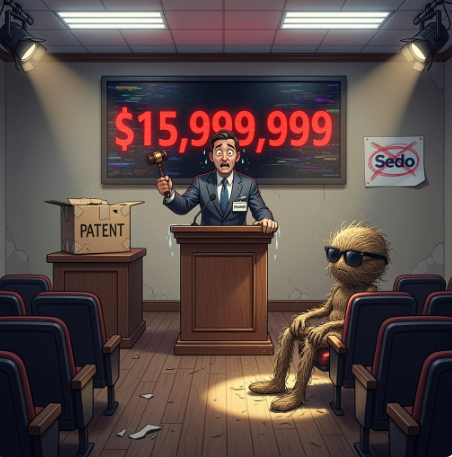
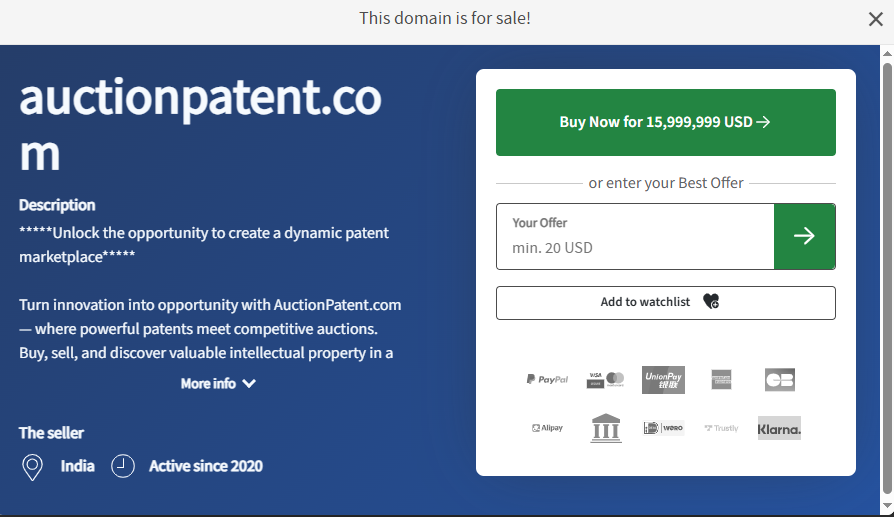
  • AuctionPatent.com – The $16 Million Domain That Has Never Seen a Single Patent (Or a Serious Buyer)

    AuctionPatent.com – The $16 Million Domain That Has Never Seen a Single Patent (Or a Serious Buyer)

    Welcome back to the roast pit. After the last episode’s deep dive into a 22-character monstrosity, the Defequer audience demanded blood. And oh, did the domain gods deliver.

    Today, we are not looking at a domain. We are looking at a laundry list of red flags stapled to a fantasy listing. Meet auctionpatent.com—a domain so confused about its own identity that it makes a square peg in a round hole look like a precision instrument.

    It is currently listed on Sedo for the low, low price of $15,999,999.

    A quick glance at the math:

    • Generated patents globally in 2024: ~3.6 million.
    • Price of this domain: ~$16 million.
    • Likelihood of the seller ever seeing a dime of that: Negative zero—and we can prove it with math, market data, and a little bit of satire.

     Introduction: When Two Buzzwords Collide and Demand a Fortune

    In the proud, unhinged ecosystem of domain flipping, few things are as intoxicating—or as ruinous—as the “platform play.” That’s when someone registers a domain with two hot keywords, slaps it on Sedo with a four‑comma price tag, and waits for a check to materialize out of thin air.

    auctionpatent.com is the quintessential example.

    Unlock the opportunity to create a dynamic patent marketplace

    Turn innovation into opportunity with AuctionPatent.com — where powerful patents meet competitive auctions. Buy, sell, and discover valuable intellectual property in a dynamic marketplace. Whether you’re an inventor or investor, this is where ideas find their true worth.

    The pitch sounds almost legitimate, doesn’t it? “Turn innovation into opportunity. Buy, sell, and discover valuable intellectual property in a dynamic marketplace.” It’s the kind of language that has graced hundreds of failed startups, abandoned white papers, and now—apparently—a domain that has existed for less than 6 months and somehow commands a price higher than the GDP of a small island nation.

    The Backstory – From Hand‑Reg to “Premium Asset” in Under Six Months

    Who Is the Seller? (a.k.a. The Spray‑and‑Pray King)

    According to Sedo, the seller is based in India and has been domaining since 2020. That is five years of experience as of 2026. Five years is enough time to learn the basics: keyword research, aftermarket pricing, and the uncomfortable truth that patent‑related domains are a niche within a niche.

    But apparently, subtlety was never part of the curriculum.

    A quick scan of the seller’s portfolio (linked in the Sedo listing) reveals a staggering pattern:

    • auction24x7.info – 850,000 EUR
    • mortgagepatent.com – 15,999,999 EUR
    • hynetworth.com – 15,999,999 EUR
    • bartersex.com – 15,999,999 EUR
    • porn247365.com – 15,999,999 EUR
    • 24x7insurance.com – 15,999,999 EUR
    • And yes, our star: auctionpatent.com – $15,999,999

    Every single domain in that portfolio—whether it’s about patents, insurance, porn, or cryptocurrency—is priced within rounding error of $16 million. Some domains have traffic counts (e.g., auctionpatent.com shows 403 visitors), but every single “Bids” column entry is 0.

    Let that sink in: Zero. Not one. Not a single serious inquiry across an entire portfolio of overpriced digital real estate.

    This is not a portfolio strategy. This is digital hoarding with a price gun.

    The Registration Date – Fresh Out of the Oven

    The WHOIS record shows this domain was registered on 2 December 2025.

    As of today (May 2026), that makes this domain barely 6 months old.

    $15,999,999 is not a price; it is a hallucination.

    The Domain Autopsy – What auctionpatent.com Actually Is (Spoiler: It’s Not Pretty)

    Length – Actually Decent (But That’s Where the Compliments End)

    Let’s get the counting right. When calculating domain length, we DO NOT count the extension (.com). We count only the characters on the left side of the dot.

    Spell it out:

     A U C T I O N P A T E N T

    • Auction = 7 letters
    • Patent = 6 letters
    • No spaces, no hyphens.

    That gives us 7 + 6 = 13 characters.

    So the domain auctionpatent.com is 13 characters long.

    On the surface, 13 characters is fine. It is not the 22‑character train wreck we saw last time. It is short enough to type without developing carpal tunnel syndrome. But length is only one variable in valuation. And here, every other variable is on fire.

     Brandability – The “Patent Auction” That Isn’t

    The seller’s pitch is beautiful, poetic even. “Turn innovation into opportunity.” It paints a picture of a bustling marketplace where inventors and investors meet to trade groundbreaking ideas.

    Now look at the name again: auctionpatent.com.

    The first and most obvious issue: auction + patent doesn’t work as a compound phrase. Are we auctioning patents? Are we patenting auctions? Are we creating a platform where patents go under the hammer? The grammar is ambiguous, and ambiguity is death for a domain.

    Successful marketplaces have crisp, memorable names: eBay.com, Sedo.com, IPExchange.com. They are either coined words or logical compounds that scan naturally. auctionpatent.com reads like someone fell asleep on their keyboard while researching “patent auction.”

    The second issue: nobody uses “auction” as the primary verb for patent trading.

    • The industry standard is IP marketplace, licensing exchange, or patent brokerage.
    • Patents are rarely pure auction items; they are negotiated, valued, and brokered over weeks or months.
    • An “auction” implies speed, transparency, and competitive bidding. Patent transfers have none of those traits in the real world.

    This is like naming a fine dining restaurant DriveThruSushi.com. It doesn’t matter how pretty the sign is; the mismatch kills the brand.

    Comparable Sales – The Data That Destroys the Price

    Let’s ground ourselves in actual market data.

    • Chat.com – sold for $15.5 million in 2023. That is a single‑word, ultra‑premium, generically powerful domain that can be used for anything from AI to social networking. It is 4 characters long.
    • DesignPatent.com – sold for $6,554 in August 2024. That is a patent‑specific domain with a clear, logical structure. Its price: low four figures.
    • The average domain sale price on Sedo in 2025: $818.
    • The median .com price on Sedo: $595.

    So we have a 13‑character, two‑keyword, 6‑month‑old domain asking $15,999,999, while the entire market of patent‑related domains barely scratches five figures.

    The conclusion is inescapable: this price has no relationship to actual market demand. It is a number pulled from a fever dream, reinforced by the echo chamber of a portfolio full of identical price tags.

    Traffic Analysis – 403 Visitors and Zero Clicks

    The Sedo portfolio shows that auctionpatent.com has received 403 visitors. That is not nothing, but in domain parking terms, 403 visitors over 6 months is modest at best.

    More damning is the Bids: 0.

    Not one person has looked at that number and thought, “Maybe I should click ‘Make Offer.’” Not one.

    Domain parking traffic can come from many sources: typos, old backlinks, or simple curiosity. But paid traffic = validation. Zero bids mean zero validation. The market has seen the price and walked away—not with anger, but with the quiet indifference that is far more insulting.

    The Seller’s Pitch – A Masterclass in Marketing Fluff

    The seller wrote:

    “Unlock the opportunity to create a dynamic patent marketplace. Turn innovation into opportunity with AuctionPatent.com — where powerful patents meet competitive auctions. Buy, sell, and discover valuable intellectual property in a dynamic marketplace. Whether you’re an inventor or investor, this is where ideas find their true worth.”

    Let’s translate that from Marketing‑Speak to English:

    • “Unlock the opportunity” → Give us 16 million for a domain that we bought for $10
    • “Dynamic patent marketplace” → A website that does not exist yet.
    • “Where powerful patents meet competitive auctions” → We have never facilitated a single transaction.
    • “Ideas find their true worth” → Apparently, true worth is $15,999,999, according to our internal math.

    This is not a business plan. This is a domain description generated by a very optimistic AI. It commits the cardinal sin of domain pitching: it describes what the buyer could do, not what the domain actually offers.

    No trademarks. No existing traffic. No developed platform. No customer base. No revenue. No social proof. Just 13 characters with a dream.

    The Defequer Delusion Index (DDI)

    We rate domains on a 1–10 scale of escalating fantasy:

    • 1–3 – Optimistic. Might find a sucker.
    • 4–6 – Overpriced by a factor of 10.
    • 7–9 – Hall of Fame delusion.
    • 10 – any random domains without significance priced at $1 trillion.

    auctionpatent.com scores a stellar 9.2 / 10.

    Why not 10? Because at least the name is short enough to spell. But the combination of:

    • A 6‑month‑old registration.
    • A seller who lists every domain at the same price.
    • Zero bids across the entire portfolio.
    • A fundamental misunderstanding of how patents are traded.
    • A price tag 2,000x above comparable sales.

    …makes this one of the most confidently wrong listings we have ever seen.

    Why This Will Never Sell (And You Can Quote Us)

    1. Patents are not auctioned like Beanie Babies. The IP transfer market is slow, relationship‑driven, and dominated by brokers and law firms. Nobody wakes up and says, “I need to impulse‑buy a patent portfolio based on a domain name I saw on Sedo.”
    2. The brand is confusing. Is it a patent auction house? An auction patent (a patent on auctions)? A content blog? The ambiguity kills any chance of organic type‑in traffic or word‑of‑mouth marketing.
    3. The seller’s credibility is shot. When you see bartersex.com and porn247365.com in the same portfolio, both priced identically to a patent marketplace, you don’t think “sophisticated IP investor.” You think “someone who bought a keyword list and a price gun.”
    4. For $16 million, buyers can get a real, established business. Or a beach house. Or a startup with actual revenue. Or Chat.com (which, again, sold for less than this listing and is infinitely better).

    Final Verdict – The Shortest Chapter Heading

    Summary of Shame

    • Asset quality: Mediocre length (13 characters), but confusing brand and zero industry fit.
    • Price sanity: None. Comparable patent domains sell for low four figures.
    • Seller experience paradox: Five years in domaining, yet still using a “spray and pray” pricing strategy.
    • Actual market value: $50 to $500 in a firesale. $0 in a rational market.
    • Likelihood of $16M sale: 0.000000001%

    Defequer Rating

    💩💩💩💩 (4/5 shits)

    “Not quite the 5‑shit masterpiece of last week’s 22‑character tragedy, but the combination of a 6‑month‑old registration and a $16 million ask is a masterclass in unearned confidence. The zero bids across the portfolio are the cherry on top of this delusion cake.”

    Disclaimer: This article is a work of satire and critical analysis. Domain values are subjective, and the author holds no position in auctionpatent.com (other than a burning desire to watch it expire).

  • WorldLifeAutobiography.com – The $6.3 Million Domain That Writes Its Own Tragicomedy

    WorldLifeAutobiography.com – The $6.3 Million Domain That Writes Its Own Tragicomedy

    In the domain world, combining three generic words doesn’t create a premium asset—it creates a mouthful. Meet WorldLifeAutobiography.com, a domain that has been patiently waiting for a buyer since 2018. The market’s response to this $6.3 million price tag is deafening silence, and we’re here to explain why.

    Introduction: When Three Generic Words Collide With One Delusional Price Tag

    In the proud and often unhinged world of domain investing, there exists a special subgenre of listing: the “kitchen sink domain.” That’s where the owner throws in every broad, emotionally resonant keyword they can think of — world, life, autobiography — hoping the sheer mass of concepts will somehow mutate into a premium brand.

    Spoiler: it doesn’t.
    It never does.

    What you get instead is a 22‑character beast of a domain (yes, exactly 22 characters to the left of the dot — count them: worldlifeautobiography = w o r l d l i f e a u t o b i o g r a p h y → that’s 22). What you get is a URL that requires three deep breaths to type and a philosophy degree to interpret.

    And yet, someone — a US‑based domainer active since 2014 — has listed this very domain on Sedo for a cool $6,300,000 USD. Registered on 9 March 2018, it has sat untouched for eight years. Not developed. Not redirected. Not even parked with dignity. Just… existing. Waiting. Dreaming.

    Today, Defequer wakes it up with a splash of cold satire.

    The Backstory – A Decade of Domaining, One Monumental Mistake

    Who Is the Seller?

    According to Sedo’s public listing, the seller is based in the United States and has been domaining since 2014. That’s twelve years of experience as of 2026. Twelve years of watching markets rise and fall, of understanding LLLL.com values, of knowing the difference between a brandable and a landfill.

    worldlifeautobiography.com

    And yet, here we are.

    The Registration Date That Keeps on Giving

    The WHOIS history tells usthat worldlifeautobiography.com was first registered on 9 March 2018.

    That means the seller was already four years into their domaining career when they hand‑registered this beauty. This wasn’t a rookie buying super-duper-cool.com in 2003. This was a veteran looking at three generic nouns and thinking: “Yes. This is my retirement.”

    Eight years of renewals later, they’ve now decided the time is ripe to demand over six million dollars.

    The market’s response: crickets, but more expensive crickets.

    Deep Structural Autopsy – Why the Name Fails at Every Level

    Length – The Typing Endurance Test

    Accuracy matters, so let’s be precise.

    The domain (without extension) is 22 characters long.

    Sequence: w o r l d l i f e a u t o b i o g r a p h y

    Count: 5 (world) + 4 (life) + 13(autobiography) = 22? Wait — careful. Let’s spell it out:

    • w o r l d = 5
    • l i f e = 4 → total 9
    • a u t o b i o g r a p h y = let’s count: a(1) u(2) t(3) o(4) b(5) i(6) o(7) g(8) r(9) a(10) p(11) h(12) y(13) → yes, “autobiography” is 13 letters.

    So 5 + 4 + 13 = 22 characters exactly. No spaces, no hyphens. Pure, unadulterated length.

    For comparison:

    • facebook.com → 8 characters
    • amazon.com → 6 characters
    • worldlifeautobiography.com → 22 characters 

    Why Length Matters for Typins and Memorability

    The average human typo rate increases exponentially after 12 characters. By 22 characters, you’re not typing a domain — you’re solving a CAPTCHA. No one will remember it after seeing it on a business card. No one will type it from a podcast mention. It will live forever in the forgotten graveyard of “I’ll Google it later.”

    Semantics – A Philosophical Car Crash

    Let’s break down the three pillars:

    • World – broad, generic, overused in failed domains since 1995.
    • Life – warm but vague. Could be anything from a blog to a suicide prevention line.
    • Autobiography – a literary genre written about oneself by oneself.

    Now ask: What would a “world life autobiography” even be?
    The autobiography of the world’s life? A platform where the planet writes its memoirs? A social network for narcissists? A biography aggregator?

    It’s not an autobiography. It’s a word salad dressed in a tuxedo, demanding to be seated at the premium domain table.

    Brandabilty Score

    CriteriaScore (out of 10)
    Memorability0
    Pronounceability1 (try saying “worldlifeautobiography” fast three times)
    Typo resistance0
    Commercial clarity0
    Extension fit3 (at least .com is there)

    Total: 4/50 → F‑minus territory.

    The Sedo Listing – A $6.3 Million Silent Film

    Price Analysis – What $6.3 Million Buys in Real Domains

    To put this in perspective:

    • voice.com sold for $30 million – a single, powerful, dictionary word.
    • it.com sold for $3.8 million – two letters.
    • worldlifeautobiography.com? Asking $6.3 million – for a 22‑character, triple‑generic, zero‑traffic, zero‑brand combo.

    Even automotive.com sold for less than

    The “I Know What I Have” Syndrome

    The lack of “make offer” option on Sedo tells you everything. The seller is not negotiating. They are waiting for a miracle. In domainer slang, this is called “priced to keep” – except it’s not even good enough to keep.

    Market Silence – The Loudest Roast

    We checked. No bids. No public interest. No whispers at domain conferences. This listing is the digital equivalent of a tumbleweed rolling through an empty saloon at high noon.

    The Defequer Delusion Index (DDI)

    We rate domains on a 1–10 scale of pure, unapologetic delusion.

    • 1–3 – Optimistic but harmless.
    • 4–6 – Overpriced but maybe a sucker exists.
    • 7–9 – Hall of Fame delusion.
    • 10 – Illegal levels of unreality.

    WorldLifeAutobiography.com score: 9.5 / 10

    Why not 10? Because 10 is reserved for shitty names  priced at $1 trillion. 9.5 means: the seller genuinely believes a 22‑character generic mashup from 2018 is worth more than a beach house in Malibu.

    A Satirical Open Letter to the Seller

    Dear 2014‑vintage domainer,

    You have held worldlifeautobiography.com since March 2018. You have renewed it faithfully. You have watched the market boom, crash, and boom again. And now, in 2026, you look at this domain and see $6,300,000.

    I see eight years of opportunity cost.

    I see twelve years of domaining experience that somehow taught you nothing about brandability.

    I see a name that belongs on a GoDaddy auction starting at $1, not Sedo’s premium showcase.

    Lower the price. Better yet, drop it. Let someone else make the same mistake for $10. You’ve suffered enough.

    With love,
    Defequer

  • The 9‑Page Bump Odyssey: One Seller, Two Domains, $24,988, and Zero Visible Interest

    The 9‑Page Bump Odyssey: One Seller, Two Domains, $24,988, and Zero Visible Interest

    There is a special kind of endurance in the domain aftermarket. It is the endurance of a seller who refuses to take hints – from the market, from other forum members, from the passage of time itself. This week, Defequer discovered a NamePros thread that began in May 2024 and is still being bumped into 2026.

    The seller: “Eminent Domain Names” (a fittingly grandiose handle).

    The domains: EminentDomainName.com (registered 29 June 2024) and EminentDomainNames.com (registered 16 February 2019).

    The asking price: $24,988 (for both, apparently – though the thread is confusing).

    The thread length: 9 pages.

    The visible outcome: No public offers. No “sold” announcement. Just bumps. Endless bumps.

    Let us roast this two‑year bump marathon from every angle – the quality of the names, the confusing pricing, the psychology of bumping, and the brutal truth about how forums actually work.

    The Name Problem – “Eminent Domain” Means Government Seizure

    Before we even discuss price or bumping, let us address the elephant in the room: Eminent domain is the legal power of a government to take private property for public use, with compensation. It is not a positive brand association.

    Imagine a company called “Eminent Domain Properties” – it sounds like they will seize your house. “Eminent Domain Names” sounds like a service that takes domains away from their owners. That is not “highly brandable.” That is highly confusing at best, mildly threatening at worst.

    The seller claims the names are “for domain name investors & brokers” and that the buyer would be an “eminent domainer.” But “eminent” (meaning distinguished or famous) is completely different from “eminent domain” (a legal concept). The seller is conflating two different words because they sound similar. That is not branding. That is a pun that does not work.

    A serious domain investor would understand that EminentDomain.com (singular) might have some value if developed into a legal news site or a government relations blog. But EminentDomainName.com and EminentDomainNames.com are clunky, long, and legally ambiguous. They are not premium assets.

    The Domains – One Veteran (2019), One Newborn (2024)

    Let us look at the two main domains:

    • EminentDomainNames.com – Registered 16 February 2019. That gives it roughly 7 years of age (as of 2026). Seven years is respectable, but age alone does not create value. The domain has no apparent development history, no backlink profile of note, and no inherent commercial demand. It is a four‑word phrase (counting “Eminent” as a word) that no business would naturally want.
    • EminentDomainName.com – Registered 29 June 2024. That is less than two years old (as of 2026). The seller registered this after starting the thread, apparently to create a “portfolio” of similar names. But adding a newer, even clunkier singular version does not increase the value of the older one. It just doubles the renewal fees.

    The seller also mentions EminentDomainer.com and EminentDomainers.com – registered at some point, though the thread is vague. So the seller is paying renewal fees on at least four mediocrities. That is not a portfolio strategy. That is a slow bleed.

    The Price – $24,988 for What, Exactly?

    The seller asks for $24,988 for both.

    What does $24,988 buy in the real domain market?

    • A genuinely strong two‑word .com with commercial intent (e.g., FastLoan.com – though that would be more)
    • A portfolio of 10–20 solid brandables
    • A meaningful marketing campaign for a startup
    • A used car

    What it does not buy is a confusing legal term with a plural “s” and a clunky “name” suffix. EminentDomainNames.com might be worth 100–100–500 to a niche legal blogger or a government affairs consultant. EminentDomainName.com is worth less – perhaps 50–50–200 as a curiosity. Combined, a realistic portfolio price would be 500–500–1,500 reseller, maybe 2,000–2,000–3,000 to an end‑user who really, really likes eminent domain puns.

    $24,988 is roughly 10‑50x the realistic ceiling. That is not “priced to sell.” That is “priced to bump until the heat death of the universe.”

    The Bump Phenomenon – A Two‑Year Marathon

    Let us talk about the thread itself. The seller started it in May 2024. As of this writing (April 2026), the thread has reached 9 pages. The vast majority of posts are the seller bumping – posting “Bump,” “Offers encouraged,” “Get lucky! Make an offer!” – with no visible engagement from other members.

    We checked the dates. The bumps are frequent. Sometimes multiple bumps per week. The seller has been doing this for nearly two years. Two years of logging into NamePros, scrolling to his thread, typing “Bump,” and hoping for a miracle.

    Here is the brutal truth: if a domain has not sold after 24 months of active bumping on a major forum, it is not the price or the exposure that is the problem. It is the domain itself.

    NamePros has thousands of active domain investors. If EminentDomainNames.com were a hidden gem at $24,988, someone would have made an offer by now. Even a lowball offer. The complete radio silence – not even a “LOL no” – tells you everything you need to know. The market has spoken. The seller is not listening.

    The Psychology of Bumping – A Sunk Cost Trap

    Why does the seller keep bumping? Simple: sunk cost fallacy.

    He paid registration fees. He spent time creating the thread. He has invested emotional energy in the idea that these domains are valuable. Admitting that they are not would mean accepting that he wasted time and money. So he keeps bumping, hoping that one day – miraculously – a buyer will appear.

    But bumping does not create demand. It only creates annoyance. After the 50th bump, regular forum users start ignoring the thread. After the 100th bump, they might even mute the seller. The seller is not increasing his chances. He is decreasing them.

    The healthy response would be: drop the price to $500, or let the domains expire. But the seller will not do that. Because that would require admitting that two years of bumps were for nothing. So the bumps will continue. Page 10. Page 11. Page 12. Until the seller runs out of renewal money or NamePros implements a “bump limit.”

    The Bottom Line – A Cautionary Tale in Domain Delusion

    EminentDomainNames.com and EminentDomainName.com are not the worst domains we have ever seen. They have a certain quirky, niche appeal. A legal blogger might buy the plural version for a few hundred dollars. A domainer with a sense of humour might pick up the singular as a conversation piece.

    But $24,988? That is not a price. That is a cry for help.

    The seller has spent two years bumping a thread that no one is reading, for domains that no one wants, at a price that no one will pay. That is not domain investing. That is a slow‑motion tragedy. And we are roasting it so that others may learn.

    If you are a domain seller reading this: listen to the market. If you bump a thread for six months with no offers, your price is too high. If you bump for a year, your domain is probably not valuable. If you bump for two years, it is time to let go. You are not being “patient.” You are being delusional.

    Defequer Rating: 💩💩💩💩 (4/5 shits)

    Four shits. Not five, because the domains themselves are merely mediocre (not trademark‑infringing or gibberish). But the two‑year bump marathon, the $24,988 fantasy price, and the complete refusal to read market signals earn a solid four. The Delusion Olympics – Bumping Division – has a new medalist.

    Roast served. Bump marathon analyzed. Next thread, please.

    Post‑Roast Note to the Seller

    Dear “Eminent Domain Names,”

    We have watched your thread. We have seen your bumps. We have counted the pages. And we have a question for you: what are you waiting for?

    You have been at this since 2024. It is now 2026. No one has bought your domains. No one has made a public offer. The only person reading your bumps is you – and now, us.

    We are not saying your domains are worthless. They might be worth something to the right buyer. But that buyer is not going to pay the price that you quoted.

    Here is our advice, offered free of charge (unlike your domains):

    1. Stop bumping. You are only embarrassing yourself.
    2. Lower the price to $500 or best offer. See what happens.
    3. If no offers after 30 days, let the domains expire. Seriously. Cut your losses.
    4. Next time, research before registering. Ask yourself: “Would a real business pay real money for this name?” If the answer is “maybe, if they love puns about government seizure,” do not register it.

    You have spent two years of your life on this thread. That is two years you could have spent learning to flip better domains. Do not waste two more.

    We will be here. Watching. And hoping you finally hear what the market is saying.

  • MyAfricaAI.com: The 9-Month-Old Buzzword Mashup Listed for $2,500,000 on Sedo

    MyAfricaAI.com: The 9-Month-Old Buzzword Mashup Listed for $2,500,000 on Sedo

    The AI hype train continues to produce some truly creative pricing strategies. Today’s exhibit: MyAfricaAI.com — registered on 28 July 2025 and now listed on Sedo with a firm BUY IT NOW price of $2,500,000.

    No “make offer” option. No room for negotiation. Just a clean seven-figure demand for a domain that is barely nine months old. The listing sits in Sedo’s premium section, looking ambitious and continental, while the market continues to offer its consistent, thoughtful response: absolute silence.

    This isn’t visionary pricing. This is “Africa + AI” keyword optimism taken to its most expensive conclusion

    My-Africa-Ai-sedo

    The Contender in the Spotlight

    MyAfricaAI.com is currently listed as a fixed-price BUY IT NOW on Sedo for exactly $2,500,000. The seller has positioned it as a premium AI + Africa play — presumably for continental tech hubs, AI development platforms, investment funds, or pan-African innovation projects. There is no detailed description, no use-case story, no traffic data, and no development history — just the domain name and the massive price tag.

    The listing promises the usual Sedo buyer protections and secure transfer, but at this price level those features feel more like polite formalities than actual selling points. Nine months after registration, the domain has attracted exactly zero visible interest or bids.

    The Backstory: July 2025 Registration Meets Immediate Multi-Million Dreams

    The domain was registered on 28 July 2025 — right in the middle of the ongoing global AI investment wave, with Africa increasingly positioned as the next frontier for tech growth. The seller apparently saw the combination of “My” (personal/ownership feel) + “Africa” + “AI” and decided this was destined to become a seven-figure brand asset.

    Instead of developing the name, building a landing page, or testing the market at realistic levels, they went straight for the nuclear option: a $2.5 million BUY IT NOW price on Sedo. This is the domain version of seeing a trending topic and immediately pricing your notebook scribble as fine art.

    Breaking Down the Domain Quality: Keyword Overload, Zero Brand Magic

    Let’s examine the name with zero continental fanfare:

    • MyAfricaAi is 10 characters long (excluding the extension). It’s a triple-keyword mashup: “My” + “Africa” + “AI.”
    • The name is extremely descriptive and generic. It sounds exactly like what it is — a placeholder for an “Africa-focused AI” project. There is almost zero unique brand personality or emotional appeal.
    • “MyAfrica” feels possessive and slightly awkward. Adding “AI” at the end turns it into a buzzword sandwich that tries to ride two hot trends at once (Africa rising + AI boom).
    • In the AI/Africa/tech space, strong brands tend to be short, memorable, and culturally resonant (think “Andela”, “Flutterwave”, “InstaDeep”, or even newer plays like “Africarare” or “PanAfricanAI”). MyAfricaAI.com feels like a conference session title or a grant proposal name, not a premium brand.

    Nine months of age is the only mildly positive factor. Everything else is textbook buzzword stuffing.

    The Delusion Factor: Nine Months Old and Already Worth $2.5 Million

    The real satire here is the speed of the ambition. Registered in July 2025, listed in 2026 for $2,500,000 with no development, no traction, and no proven demand. The seller is treating a fresh hand-registration as if it’s already a mature, continent-scale AI platform with built-in equity.

    This level of optimism ignores basic market realities: even strong geo + tech combination domains rarely command seven figures unless they are exceptionally short, brandable, or have real traction and cultural resonance. The complete lack of interest on Sedo is the market’s polite way of saying “nice try, but no.”

    Realistic Valuation: What the Silence Is Telling Us

    The AI boom and Africa’s growing tech scene are both very real, but combining hot keywords does not automatically create a premium brand. Strong names in this space need to be short, memorable, culturally resonant, and emotionally compelling — not a descriptive mashup that sounds like a project title. If you’re going to chase geo + AI trends, at least register something that doesn’t feel like it was generated by a keyword combiner tool.

    The Defequer Verdict

    CategoryRating
    Name Quality⭐☆☆☆☆ (1/5)
    Appraisal Sanity⭐☆☆☆☆ (1/5)
    Actual Market Value⭐☆☆☆☆ (1/5)
    Likelihood of $2.5M Sale0.00%

    Defequer Rating: 💩💩💩💩💩 (5/5 shits — registering a triple-keyword AI + Africa mashup in July 2025 and listing it for $2.5 million nine months later is peak buzzword delusion.)

    MyAfricaAI.com isn’t the worst name we’ve seen, but at $2,500,000 it’s comedy gold. The market has spoken with its silence. Drop the price dramatically or prepare for another quiet year watching the renewal notices roll in.

    Got more seven-figure geo-AI dreams, fresh buzzword mashups, or any other over-hyped Sedo listings you want roasted? Don’t hesitate to let us know. We’re always flushing the fluff — one overpriced continental dream at a time.

error: Content is protected !!